
Cancer now links my daughter and my father. I am equally helpless with both. Jelly.
I watch my daughter joking, hearing between the words the fear of the unknown.
I watch her face as she shares an update on my father that comes through my brother indirectly as he warns us to no longer consider a hospital recommended the week before. Now, my brother is unsatisfied with the care given my dad as he lets it slip that there is no feeling below the arms, that he expects The Call any day.
I think of the last conversation with my dad, the day I had to tell him what my daughter had. I heard his voice, and wish I had not. I wish I could have held forever the memory of what his voice was, not what it is. He spoke for a long time and I could feel love and fear, even as it was impossible to decipher the actual words.
I am not the perfect daughter. Not even the good daughter. I thought there would be more time, that first I had to be strong. And then, when I was ready to hear more stories, ready to make more decisions, I had to leave again. We are good at postponing, it is our tradition.
News of test results slip into conversations between my daughter and nurses or receptionists. But, then, as if they realize what was just revealed they stop reeling off the results and say the doctor will explain all of this on Thursday. Thursday can't come fast enough. Thursday should never come.
We talk of hoping that her hair will grow back curly, of a friend's offer to turn her mane into a wig, the weirdness of where hair grows and where it doesn't.
I listen. I worry. I collect information, I help where I can, I answer the emails and phone calls. I debate - how much truth can she hold now and what is the truth.
For years, it has been my father and my daughter who have visited me at the hospitals, who offered their own brands of humor and caring to nurse me through challenges.
It is hard to believe that now I am to be the strong one, the filling between the two generations stung by cancer.
November 11, 2008

November 10, 2008
Fill my ceiling with Twitter, more
I watch the world waken as Twitters slide into my account. Sometimes another screen holds Facebook statuses. Pump in Friendfeed and RSS
On days like today, when only my mind escapes the concrete truck's dump, I so need that reach of humanity. Even when the mushiness of my mind prevents timely responses, I want to read the echos of the world
Make me laugh. Make me think. Make me smile.
Above me lies - again - a boring white ceiling. Imagine the Twitters, the statuses, the feeds floating across in ink-jet perfection. 72 point? Or larger?
This distraction that could render useless the need for yet another numbing pill on days when holding the iPhone hurts as much as carrying your world.
But like the old man who remembers his roof leaks only when it is raining, these ideas of constructive distraction come only when I am incapable of implementing. Unlike the old man in the fiddle performance, the conversation is one sided. The only sound comes from the iPhone - until the battery dies or someone who can move comes home.
I watch from afar as the world starts to sleep, imprisoned by playing a normal person yesterday.
November 9, 2008
The past creates shadows on today
I am breaking a lot of self-imposed rules, ironically while reading others who write about online friendships.
I am writing on the iPhone (makes it hard to cite URLs) but last night as I reviewed another day of firsts, I started thinking about some posts that have caught my brain. There was Louis Gray, who reminded how sometimes we can help our virtual friends in the real world with a gesture as simple as using PayPal to pay a bill for someone in need. Kate Carruthers wrote about this need we have to know who are friend and who are foe.
I remember jumping yesterday, sharing everything about my server in the hopes a problem could be solved while I shivered my way through a night of badly needed sleep. I could hear my grandfather shouting, reminding me not to trust anyone, not even my own mother. Yet, I gave everything - more then was needed - because I was so tired of wrestling with permissions, passwords, scripts, etc.
I just surrender. My favorite books, notes and even techies are nine hours away. I am too fragile today to open my email, to check the server, to see if what was promised was done and that all is right in the world.
I want to believe .... at least for awhile longer. Friend or foe? Why can't I believe what I know from the eyes and the heart?
My grandmother probably turned over in her grave, too, as she watched me create a fake Alfredo sauce from cream cheese and other surprises. I cry later over the dinner too. I am finally cooking - but not in the place I so much want to be right now. I cry because I can't cuddle. I cry because I am cold.
I just cry. That makes me mad because big girls don't cry. Mothers don't cry. I don't cry.
I jokingly say I hope a recommended book has a chapter on how to stop all the crying. The emailed reply explains "The tears were there, crying releases them."
I carry the thought today as I visit Big Lots for the first time, demand (nicely) a printed newspaper and tell my credit card company that it is me making these out of character purchases in multiple states and yes, online, too
My daughter and I look for a college course, try on marked-down Halloween wigs, make plans for the years down the road, and ...
And I wait until I close the door on the game room turned bedroom to cry once more, wanting to believe I trusted, trust the right people, the right things, the right doctors, the right words, the right everything.
The fears are there; crying sometimes releases them.
The past is here with the people who preached and the choices I made. The new movements release the unnecessary to allow survival.
And I cry.
Updated 5/13/09 with links and fixes like . verb tenses and spelling.
I am writing on the iPhone (makes it hard to cite URLs) but last night as I reviewed another day of firsts, I started thinking about some posts that have caught my brain. There was Louis Gray, who reminded how sometimes we can help our virtual friends in the real world with a gesture as simple as using PayPal to pay a bill for someone in need. Kate Carruthers wrote about this need we have to know who are friend and who are foe.
I remember jumping yesterday, sharing everything about my server in the hopes a problem could be solved while I shivered my way through a night of badly needed sleep. I could hear my grandfather shouting, reminding me not to trust anyone, not even my own mother. Yet, I gave everything - more then was needed - because I was so tired of wrestling with permissions, passwords, scripts, etc.
I just surrender. My favorite books, notes and even techies are nine hours away. I am too fragile today to open my email, to check the server, to see if what was promised was done and that all is right in the world.
I want to believe .... at least for awhile longer. Friend or foe? Why can't I believe what I know from the eyes and the heart?
My grandmother probably turned over in her grave, too, as she watched me create a fake Alfredo sauce from cream cheese and other surprises. I cry later over the dinner too. I am finally cooking - but not in the place I so much want to be right now. I cry because I can't cuddle. I cry because I am cold.
I just cry. That makes me mad because big girls don't cry. Mothers don't cry. I don't cry.
I jokingly say I hope a recommended book has a chapter on how to stop all the crying. The emailed reply explains "The tears were there, crying releases them."
I carry the thought today as I visit Big Lots for the first time, demand (nicely) a printed newspaper and tell my credit card company that it is me making these out of character purchases in multiple states and yes, online, too
My daughter and I look for a college course, try on marked-down Halloween wigs, make plans for the years down the road, and ...
And I wait until I close the door on the game room turned bedroom to cry once more, wanting to believe I trusted, trust the right people, the right things, the right doctors, the right words, the right everything.
The fears are there; crying sometimes releases them.
The past is here with the people who preached and the choices I made. The new movements release the unnecessary to allow survival.
And I cry.
Updated 5/13/09 with links and fixes like . verb tenses and spelling.
November 7, 2008
Culture shock: Living with 24-year-olds, living here
I did not expect smooth sailing when I moved in with my daughter and her boyfriend. It is surprising, to me, the things that shock me.
Like, I have learned to bring my own reading material now to the waiting rooms of the hospitals and clinics near this small Tennessee town. First, I never know if I will have Internet access. And second, I'm a reader and I guess many folks around here are not. Otherwise, why so many out-of-date magazines.
I now look to see what is the newest magazine and the oldest magazine in the designated waiting area. Yesterday, the oldest was from 2002 and the newest from 2006.
Today, I read Wired while waiting. Imagine my surprise when I was asked if it was a home magazine. Really. I left the magazine behind so perhaps she read it.
I missed the changing of the leaves in Michigan so it is nice to catch them here in Tennessee. However, I would like some horizontal parking lots here. It is a struggle to get out of the car each time we stop.
The city I left was fairly Democratic; the one I am in now swings Republican. That led to a whole new set of political ads the days of the campaign and conversations I am sure I would not have heard back home. Interesting, but different. OK, I don't want to hear any more about the KKK.
Last, but not least, is finding the differences in how 24-year-olds live. I am discovering new TV programs and channels, new foods, new routines and even some new attitudes.
Did I mention the futon? Or exercise machine that is my clothes closet?
I also discovered the advantages of being first up are a hot shower and a fast Internet connection. Boy, games are Internet hogs :-)
Like, I have learned to bring my own reading material now to the waiting rooms of the hospitals and clinics near this small Tennessee town. First, I never know if I will have Internet access. And second, I'm a reader and I guess many folks around here are not. Otherwise, why so many out-of-date magazines.
I now look to see what is the newest magazine and the oldest magazine in the designated waiting area. Yesterday, the oldest was from 2002 and the newest from 2006.
Today, I read Wired while waiting. Imagine my surprise when I was asked if it was a home magazine. Really. I left the magazine behind so perhaps she read it.
I missed the changing of the leaves in Michigan so it is nice to catch them here in Tennessee. However, I would like some horizontal parking lots here. It is a struggle to get out of the car each time we stop.
The city I left was fairly Democratic; the one I am in now swings Republican. That led to a whole new set of political ads the days of the campaign and conversations I am sure I would not have heard back home. Interesting, but different. OK, I don't want to hear any more about the KKK.
Last, but not least, is finding the differences in how 24-year-olds live. I am discovering new TV programs and channels, new foods, new routines and even some new attitudes.
Did I mention the futon? Or exercise machine that is my clothes closet?
I also discovered the advantages of being first up are a hot shower and a fast Internet connection. Boy, games are Internet hogs :-)
November 4, 2008
Hotel of huggers, great service
My recent stay at a Marriott was bookmarked by service beyond the expected.
I love driving - especially when the traffic is light and good music is filling the car. The four-hour drive to Indianapolis brought back memories of many road trips as a roadie, a musician and a festival organizer. Only now, I could stay in touch with family and friends with a txting splash at each road stop.
I have been to Indianapolis enough times now - to visit friends and IUPUI for seminars and computer-assisted reporting workshops - that I should have remembered how much I don't like getting into the downtown area. The twists and turns are confusing.
Plus, add to the last-minute rush getting ready to go see my daughter in Tennessee after the convention. It added up to a tired woman checking into the hotel about 10 p.m. on a Saturday night.
Guess I looked bad - the hotel gave me room 444 because they said I looked like I needed an easy number to remember - and that was before I discovered my iPhone was missing.
Fortunately, the man who carried in my bags, boxes and suitcases - and I had a lot - went back to my car and found the missing phone.
The second night was broken up by a fire alarm - false - but the rest of the stay uneventful until I tried to leave.
On Wednesday night, I was to get a roommate. So, I had arranged for her name to be added to my hotel room. At 1 p.m., I learned about my daughter's cancer. At 10 p.m., I listened to a voice mail from the potential roommate who thought I was staying at a different hotel and had given up and gotten another room
When I checked out, I was surprised that there was nothing extra on my bill, but I was a little distracted so didn't review as carefully as I usually do.
Something made me stop, though, and I suddenly noticed that the bill showed I had been there one night only. Then, I noticed the bill was for the woman who never checked in. I explained that she hadn't checked in so she couldn't check out and that I needed my bill.
I burst out crying (and gee, I thought I had already cried all that I could). The clerk came out from behind the counter to hug me, then quickly got the right bill -- which did have parking and Internet charges -- and assured me they would sweep my room to see if I forgot anything. They also assured me that that the other woman was no longer assigned to the room.
It took nearly 30 minutes to cross the lobby as Girl Scout friends first greeted me with joy, then disappointment as they learned I was leaving and why. It was a lobby of hugs.
By then, the bellhop and car guys had loaded my car, filled my coffee cup, fixed my map and they, too, hugged me before I left.
I love driving - especially when the traffic is light and good music is filling the car. The four-hour drive to Indianapolis brought back memories of many road trips as a roadie, a musician and a festival organizer. Only now, I could stay in touch with family and friends with a txting splash at each road stop.
I have been to Indianapolis enough times now - to visit friends and IUPUI for seminars and computer-assisted reporting workshops - that I should have remembered how much I don't like getting into the downtown area. The twists and turns are confusing.
Plus, add to the last-minute rush getting ready to go see my daughter in Tennessee after the convention. It added up to a tired woman checking into the hotel about 10 p.m. on a Saturday night.
Guess I looked bad - the hotel gave me room 444 because they said I looked like I needed an easy number to remember - and that was before I discovered my iPhone was missing.
Fortunately, the man who carried in my bags, boxes and suitcases - and I had a lot - went back to my car and found the missing phone.
The second night was broken up by a fire alarm - false - but the rest of the stay uneventful until I tried to leave.
On Wednesday night, I was to get a roommate. So, I had arranged for her name to be added to my hotel room. At 1 p.m., I learned about my daughter's cancer. At 10 p.m., I listened to a voice mail from the potential roommate who thought I was staying at a different hotel and had given up and gotten another room
When I checked out, I was surprised that there was nothing extra on my bill, but I was a little distracted so didn't review as carefully as I usually do.
Something made me stop, though, and I suddenly noticed that the bill showed I had been there one night only. Then, I noticed the bill was for the woman who never checked in. I explained that she hadn't checked in so she couldn't check out and that I needed my bill.
I burst out crying (and gee, I thought I had already cried all that I could). The clerk came out from behind the counter to hug me, then quickly got the right bill -- which did have parking and Internet charges -- and assured me they would sweep my room to see if I forgot anything. They also assured me that that the other woman was no longer assigned to the room.
It took nearly 30 minutes to cross the lobby as Girl Scout friends first greeted me with joy, then disappointment as they learned I was leaving and why. It was a lobby of hugs.
By then, the bellhop and car guys had loaded my car, filled my coffee cup, fixed my map and they, too, hugged me before I left.
October 31, 2008
Blogger writes about Conversations that Matter, while others use Twitter
The National Girl Scout Convention is getting some attention outside the walls.
Jack Martin Leith talks about the Conversations That Matter, learning about them through a post by Christine Whitney Sanchez, on the Open Space Technology e-list.
Jack quotes Christine:
@skap5 says" K Cloninger CEO of Girl Scouts flipped business model on its head." Membership orgs?
Girl Scouts of the USA model participatory democracy using Open Space, World Cafe & Appreciative Inquiry. www.jackmartinleith.com/?p=... about 14 hours ago from web
Also excited to be here is PJClou9 from Minnesota, who tweeted just a few minutes ago:
Early her Tweets included this:
"Hoping everyone's Halloween festivities are ready to roll. I am going to eat dinner than Wii w/Girls Scouts til 8. "
Here's another Tweet:
skap5: @jackmartinleith I spoke with Kathy Cloninger CEO of Girl Scouts recently and she is fantastic. Flipped the business model on its head.
And another:
brandologist: Went to opening ceremonies of Girl Scouts annual convention tonight. Mayor Ballard read proclamation of today as Girl Scouts day.
CMCMediaGroup: covering the girl scouts convention
Did I miss anyone?
This originally appeared in Convention Talk, a discussion board set up by the national Girl Scouts organization.
.
Jack Martin Leith talks about the Conversations That Matter, learning about them through a post by Christine Whitney Sanchez, on the Open Space Technology e-list.
Jack quotes Christine:
"The 900 person Open Space for Sharing and Learning has just concluded with members posting 62 topics over two sessions. Picture girls standing at the microphones, thanking the adults for truly listening to them and adults tearfully expressing their passion and gratitude for everything they learned. Lisa Heft did a magnificent job of holding the space and inviting new thinking."He also Twittered several times about Girl Scouts, including these Tweets
@skap5 says" K Cloninger CEO of Girl Scouts flipped business model on its head." Membership orgs?
Girl Scouts of the USA model participatory democracy using Open Space, World Cafe & Appreciative Inquiry. www.jackmartinleith.com/?p=... about 14 hours ago from web
Also excited to be here is PJClou9 from Minnesota, who tweeted just a few minutes ago:
"Having fun at Girl Scout convention!"
Early her Tweets included this:
"Hoping everyone's Halloween festivities are ready to roll. I am going to eat dinner than Wii w/Girls Scouts til 8. "
Here's another Tweet:
skap5: @jackmartinleith I spoke with Kathy Cloninger CEO of Girl Scouts recently and she is fantastic. Flipped the business model on its head.
And another:
brandologist: Went to opening ceremonies of Girl Scouts annual convention tonight. Mayor Ballard read proclamation of today as Girl Scouts day.
CMCMediaGroup: covering the girl scouts convention
Did I miss anyone?
This originally appeared in Convention Talk, a discussion board set up by the national Girl Scouts organization.
.
Big blow: Daughter, 24, has cancer
It's getting tiring to hear how unexpected it is for a 24-year-old to have cancer. To fight the insurance battles so soon. And to know how fast we must act.
I left Michigan on Sunday to drive to Indiana to get ready for the Girl Scout Convention, where a project was to drive Conversations That Matter and get girls to become digital storyweavers.
On Wednesday afternoon, I got the unbelievable news that my daughter has breast cancer. For the rest of the day, the phrase "first, you cry" came to mind as the tears just kept coming. I knew they needed to be out of my system before I made it to Tennessee where my daughter now lives.
The people I had been working with were wonderful - understanding why I had to leave and several people added to their jobs and new ones stepped up to take over some of the things I had taken on.
They also quickly provided support in numerous ways, making sure I ate, rested and surrounded with hugs and love.
I drove from Indy to Tennessee, through construction and detours, stopping frequently to stretch, and rewarded by being able to hug my daughter.
Today, we spent at the Hope Cancer Center learning how much we don't know yet and getting scared by what we know. One thing for sure is that it is aggressive and treatment needs to start ASAP. But first, we need to know more:
Is the cancer in one place? That requires more tests, which the insurance company says it must precertify the need first.
Did the pathologist have more information and it is just the fax that is missing it?
Yet, the doctor was frank: surgery, chemo and radiation is necessary. What's left is how much and when. And for that we need some of the blood results back, an MRI and a cat scan done.
Looks like we have found another good reason I took the buyout. I can now live in Tennessee and help my daughter survive choosing a doctor, a treatment plan and then living through it. Perhaps I can find a way to stop the weight loss, the pain.
Perhaps, my being here will help my daughter - already determined she will fight and win. In fact, she went to work today at her pizza place. She's swamped with customers, can barely stay awake and yet says she needs work to help her focus.
Much in the same way, I'm trying to help with the Girl Scout convention long distance.
But mostly, I still want to cry at the unfairness even as I know nobody ever said life was fair.
I left Michigan on Sunday to drive to Indiana to get ready for the Girl Scout Convention, where a project was to drive Conversations That Matter and get girls to become digital storyweavers.
On Wednesday afternoon, I got the unbelievable news that my daughter has breast cancer. For the rest of the day, the phrase "first, you cry" came to mind as the tears just kept coming. I knew they needed to be out of my system before I made it to Tennessee where my daughter now lives.
The people I had been working with were wonderful - understanding why I had to leave and several people added to their jobs and new ones stepped up to take over some of the things I had taken on.
They also quickly provided support in numerous ways, making sure I ate, rested and surrounded with hugs and love.
I drove from Indy to Tennessee, through construction and detours, stopping frequently to stretch, and rewarded by being able to hug my daughter.
Today, we spent at the Hope Cancer Center learning how much we don't know yet and getting scared by what we know. One thing for sure is that it is aggressive and treatment needs to start ASAP. But first, we need to know more:
Is the cancer in one place? That requires more tests, which the insurance company says it must precertify the need first.
Did the pathologist have more information and it is just the fax that is missing it?
Yet, the doctor was frank: surgery, chemo and radiation is necessary. What's left is how much and when. And for that we need some of the blood results back, an MRI and a cat scan done.
Looks like we have found another good reason I took the buyout. I can now live in Tennessee and help my daughter survive choosing a doctor, a treatment plan and then living through it. Perhaps I can find a way to stop the weight loss, the pain.
Perhaps, my being here will help my daughter - already determined she will fight and win. In fact, she went to work today at her pizza place. She's swamped with customers, can barely stay awake and yet says she needs work to help her focus.
Much in the same way, I'm trying to help with the Girl Scout convention long distance.
But mostly, I still want to cry at the unfairness even as I know nobody ever said life was fair.
Open Space starts with listing ideas
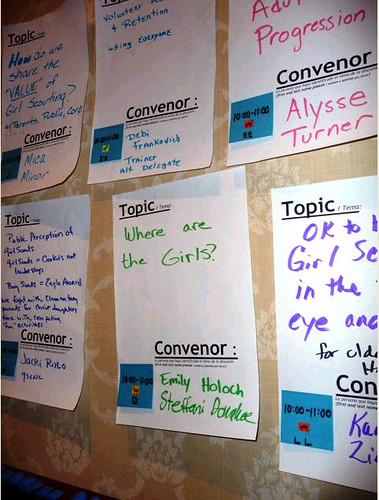 The idea of self organizing through Open Space fascinates me. It's the ultimate in showing democracy rules, that the crowd is wise.
The people present at Open Space determine what will be discussed during the session. Before I left Indy for a family emergency, Gabriel Shirley took time from his from his Digital Production and Digtial StoryWeaving duties to give me a quick tour and explanation of Open Space.
I watched girls and women go to a table, pick up a note that listed the issue they wanted to talk about, announce it over a microphone and then go post it on the "wall."
Later, I took a few minutes to look over some of the topics that people wanted to talk about and had posted on the wall. I was glad that someone took this photograph to help me preserve this memory.
I heard lead facilitator Lisa Heft announce that the enthusiasm of the group meant Open Space volunteers had to expand the number of topic groups. That was exciting. so was seeing girls among the adults.

Volunteers are working to transcribe the discussion and plans created by self-organizing groups. I'm hungry for information from the convention floor as well as from open space.
Originaly posted in Convention Talk, a new discussion board for the national Girl Scouts organzation.
October 28, 2008
GS Central unfolds in Indy
It's been inspiring to watch the Indy convention center unfold into Girl Scout Central.
The city too! I came back to my hotel tonight to discover a request to share my unused lotion, shampoo, etc. by putting it in the provided Girl Scout bag for a local service project
Speaking of donations ... got time to help some of us transcribe what happens at Open Space (a few spots left - register at 8 Thursday). Stop by StoryWeaving Cental anytime after 3:30 Thursday. That transcribing will take awhile so if you can't make it Tursday stop by another day.
We also want to share results from conversations. If you are willing to text for those who can't stop by, get a Ask Me About texting sticker. During or after the business meeting just text when asked, see if a conversation supporter (in aprons) has collected written thoughts by non- texters that you can text or stop by StoryWeaving Central to see what we have collected.
You will be able to see texting results live on screens at convention and via a web site plus on some printouts.
Oh and we are looking for people who were at 2005 convention to interview. Plus we need folks willing to journal about this year's convention.
We have other needs posted on site. Stop by. Say hello!
Originally posted in Convention Talk, a discussion board created by the national Girl Scouts.
The city too! I came back to my hotel tonight to discover a request to share my unused lotion, shampoo, etc. by putting it in the provided Girl Scout bag for a local service project
Speaking of donations ... got time to help some of us transcribe what happens at Open Space (a few spots left - register at 8 Thursday). Stop by StoryWeaving Cental anytime after 3:30 Thursday. That transcribing will take awhile so if you can't make it Tursday stop by another day.
We also want to share results from conversations. If you are willing to text for those who can't stop by, get a Ask Me About texting sticker. During or after the business meeting just text when asked, see if a conversation supporter (in aprons) has collected written thoughts by non- texters that you can text or stop by StoryWeaving Central to see what we have collected.
You will be able to see texting results live on screens at convention and via a web site plus on some printouts.
Oh and we are looking for people who were at 2005 convention to interview. Plus we need folks willing to journal about this year's convention.
We have other needs posted on site. Stop by. Say hello!
Originally posted in Convention Talk, a discussion board created by the national Girl Scouts.
Meet a StoryWeaver
A big part of the effort at the Girl Scouts annual convention is to use story to connect people.
In Convention Talk, the online discussion board for Girl Scouts, I wrote:
In Convention Talk, the online discussion board for Girl Scouts, I wrote:
Remember back in July 2008 when the first Convention Connections newsletter was distributed to Girl Scout Councils and posted on the convention web site. One article suggested we practice story-telling by thinking about our own Girl Scout experiences, including leadership lessons and special people who had an impact on our lives..
In the past three months, I've "met" some incredible people by becoming involved in the StoryWeaver project. (I put met in quotes because those meetings have happened over the phone and on the web.) And I love hearing, reading and seeing their stories, especially their Girl Scout stories.
One of the first people I "met" was Gabriel Shirley But Christine Whitney Sanchez was the second.
I've been inspired to do a little weaving thanks to Lou Creber, who was heading up the Story Looms and organizing the Elders and Greeters. Unfortunately, Lou won't be in Indy.
I did get to meet Nancy Moeller, when I went to Macy and did some practice texting and worked with three girls who used borrowed video cameras to interview adults about their Girl Scout leadership stories. (Watch for the videos soon, and watch for the girls in Indy.)
Meanwhile, keep coming back through the convention.
UPDATE: Lou did make it to convention - she arrived on Wednesday. I still didn't get to meet her as I had to leave to be with family. (Yes, before the official opening of the convention. Thank goodness for the Internet)
October 27, 2008
So many firsts: Some alarming, some scary
It's not often I get to have so many firsts on the same day/night. Let's see, 3 a.m. false fire alarm at hotel, a few scary phases and then all those new people. I survived.
We'll go backwards and start with the fire alarm that sounded at 3 a.m. in the hotel. I was almost ready to make the trip down to the stairs when the announcement came on and said it was false. Nice wakeup call.
Of course, I'm wondering if it is related to the problem of no hot water earlier today at the hotel.
Earlier in the day, I finally got to meet with some folks who really made the last three months of my life beyond interesting. I've talked with them on the phone (almost daily in some cases), exchanged lots of emails (definitely daily) and txted some (including sending one a message meant for my husband (must be careful).
Still despite that Dale Carnegie class, despite hosting a radio show, despite speaking on stage before thousands, was I ready to walk in the lobby and say hey? (They have all met before).
They didn't bite. Well, not at least until dinner.
The day started off scary - seems that a prescription is missing. I unpacked everything - including the stuff I packed for the time I'll spend in Tennessee. Nothing. My theory is the dog ate the pills, grabbing the box during the round of packing. Whatever. That left me with finding a way to get refills. (OK, first I debated skipping the prescription, but since I already skipped the flu shot I thought that might be too scary.)
I don't like it, however, when the concierge tells me "I should be safe there."
Actually, there was no reason to be scared of the drugstore or meeting the folks I could never call strangers. Dinner was much more of a family affair.
We'll go backwards and start with the fire alarm that sounded at 3 a.m. in the hotel. I was almost ready to make the trip down to the stairs when the announcement came on and said it was false. Nice wakeup call.
Of course, I'm wondering if it is related to the problem of no hot water earlier today at the hotel.
Earlier in the day, I finally got to meet with some folks who really made the last three months of my life beyond interesting. I've talked with them on the phone (almost daily in some cases), exchanged lots of emails (definitely daily) and txted some (including sending one a message meant for my husband (must be careful).
Still despite that Dale Carnegie class, despite hosting a radio show, despite speaking on stage before thousands, was I ready to walk in the lobby and say hey? (They have all met before).
They didn't bite. Well, not at least until dinner.
The day started off scary - seems that a prescription is missing. I unpacked everything - including the stuff I packed for the time I'll spend in Tennessee. Nothing. My theory is the dog ate the pills, grabbing the box during the round of packing. Whatever. That left me with finding a way to get refills. (OK, first I debated skipping the prescription, but since I already skipped the flu shot I thought that might be too scary.)
I don't like it, however, when the concierge tells me "I should be safe there."
Actually, there was no reason to be scared of the drugstore or meeting the folks I could never call strangers. Dinner was much more of a family affair.
Study: Txting helps parent-teen relationship
I think I already knew this but it's nice to have some confirmation - even if the study was funded by a phone company.
Sometimes, it pays to clean out the files from your computer. I'm trying to make sure I'll have lots of space for video, text messages and other items from the Girl Scout national convention so I'm tossing a few things.
I re-discovered a study released in April that found that parents who text may have a better relationship with their teens:
A press release on the survey is available. So is a video with teens and parents talking more about why they text.
originally posted in ConventionTalk, a discussion board created on the national Girl Scout web site to discuss the national convention/meeting of delegates.
Sometimes, it pays to clean out the files from your computer. I'm trying to make sure I'll have lots of space for video, text messages and other items from the Girl Scout national convention so I'm tossing a few things.
I re-discovered a study released in April that found that parents who text may have a better relationship with their teens:
- More than half (53%) of teens that text message think their relationship with their parents has improved because of text messaging.
- More than half (51%) of parents who text with their teens agree that they communicate more often with their kids now than they did before they began text messaging and that text messaging has actually improved their relationship.
A press release on the survey is available. So is a video with teens and parents talking more about why they text.
originally posted in ConventionTalk, a discussion board created on the national Girl Scout web site to discuss the national convention/meeting of delegates.
October 26, 2008
Helicopter or chicken soup mom: How do you decide
Struggle time - just when should a mom drop everything to be with her daughter? Is support from miles away enough? Or should I leave this event and drive six hours to be next to her just in case the biopsy finds cancer?
But what if the results are not in? If it's not cancer?
Am I listening to the words and missing the meaning when she says "please, wait to come."
Will it be enough to wait by the phone? To send warm, encouraging thoughts.
Oh mom, what should this mom do?.
But what if the results are not in? If it's not cancer?
Am I listening to the words and missing the meaning when she says "please, wait to come."
Will it be enough to wait by the phone? To send warm, encouraging thoughts.
Oh mom, what should this mom do?.
October 23, 2008
I voted - but it wasn't easy getting a ballot
Unbelievable is the only way to describe the way the absentee ballot system runs in Grand Blanc Township, near Flint, Michigan.
I'm heading out of town and originally expected to return the day before the election.
My daughter will soon get a biopsy so I want to extend my trip - by days and places - and spend some time with her.
It is a last minute decision, so I stopped by my local government office to get an absentee ballot. That's when the unbelievable part started.
I needed the paper ballot now, not mailed to me at the house I wouldn't be at until after the election. I also didn't want it mailed to a hotel.
Instead, I was told that legally it was impossible to give me a ballot now.
As I pressed the issue, I was told that it would be too confusing to do it now but I could call the next day, make an appointment and come in to get a ballot. And no, I couldn't tell her what time I was coming the next day, I had to call the next day.
By the time, I reached my car I was fuming. First call went to the county election department - very helpful. She led me to the state elections department. In between, a search of regulations and court rulings.
The county and state were sure I had heard wrong and the state even called the township to clarify.
I got my ballot. It took a while - long enough for one official to have a long discussion with me about how busy they are and can't really provide a ballot to every person who wants one on their time.
A steady stream of people came in and out during the two hours I was there. Each filled out the required absentee ballot request and patiently nodded when told the ballot would be mailed to them. Guess we have money to burn in my local government as we certainly wouldn't want to save on postage by handing them a ballot.
So a future fight, on another day I blackened the holes; let's see if it gets counted.
I'm heading out of town and originally expected to return the day before the election.
My daughter will soon get a biopsy so I want to extend my trip - by days and places - and spend some time with her.
It is a last minute decision, so I stopped by my local government office to get an absentee ballot. That's when the unbelievable part started.
I needed the paper ballot now, not mailed to me at the house I wouldn't be at until after the election. I also didn't want it mailed to a hotel.
Instead, I was told that legally it was impossible to give me a ballot now.
As I pressed the issue, I was told that it would be too confusing to do it now but I could call the next day, make an appointment and come in to get a ballot. And no, I couldn't tell her what time I was coming the next day, I had to call the next day.
By the time, I reached my car I was fuming. First call went to the county election department - very helpful. She led me to the state elections department. In between, a search of regulations and court rulings.
The county and state were sure I had heard wrong and the state even called the township to clarify.
I got my ballot. It took a while - long enough for one official to have a long discussion with me about how busy they are and can't really provide a ballot to every person who wants one on their time.
A steady stream of people came in and out during the two hours I was there. Each filled out the required absentee ballot request and patiently nodded when told the ballot would be mailed to them. Guess we have money to burn in my local government as we certainly wouldn't want to save on postage by handing them a ballot.
So a future fight, on another day I blackened the holes; let's see if it gets counted.
October 19, 2008
Faith: The bigger picture
I collect quotes - for inspiration, for cards, for journaling, and now for blogging. I was stopped by what one mother said about her son's recovery in a recent newspaper article.
The 14-year-old was hit by a car while riding his bike. The mother was praying. And though she hoped for recovery, that is not what she prayed for:
Kelly Thornsberry, who was quoted in The Flint Journal on Oct. 19, 2008, page A4, has the bigger picture in mind. She reminds me once again that our children are not ours, no matter how much we would like to think they are.
The 14-year-old was hit by a car while riding his bike. The mother was praying. And though she hoped for recovery, that is not what she prayed for:
"I wanted God's will to be done no matter what it was because he knows my son better then I know my son....he knows what kind of life (Chris is) going to live - I don't.
Kelly Thornsberry, who was quoted in The Flint Journal on Oct. 19, 2008, page A4, has the bigger picture in mind. She reminds me once again that our children are not ours, no matter how much we would like to think they are.
October 14, 2008
It's a tradition: Change and griping
"What Happened to the Girl Scouts" is the headline on a magazine article that comes up in an Internet search. I'm amazed that mass media has picked up on the changes, an undercurrent of dissatisfaction in Girl Scouts.
Will it be about the merging of councils, the changing of programs, or lambasting the values? Is it pegged to the 51st National Council meeting in Indianapolis Oct. 29-Nov.2?
It is a look at values - the downplaying of international relationships. It is a look at changes - a handbook revised just 11 months after being published.
Nice - an article written in 1955 - has words that connect with today's Girl Scouts.
What pops out for me in the May 1955 Atlantic article is this:
So change is a tradition.
So revision is a tradition.
Author Ben H. Bagdikian, "one of the first to be alarmed by the policy of retreat disclosed in the article which follows" carefully looks for evidence that Girl Scouts, the organization, has changed its thinking, its values. He cites examples like this:
So debating the inclusion or exclusion of a phrase in documents is a tradition.
Today's hot topic on the Internet e-mail lists is that "they" are against "unhealthy traditionalists."
The phrase - an obstacle to changing a program - is found in a table cell in a "Strategic priority" document shared with a Yahoo group on Feb 16, 2008:
"There is an unhealthy devotion to traditions on standards, uniforms and
awards."
Another shares that she saw the phrase as "an unhealthy attachment to tradition" in a PowerPoint she was forced to watch. Later, someone sends out a PowerPoint from an annual meeting where it was held.
Now, a group has ordered shirts that say Unhealthy Traditionalist: Eat 2 Thin Mints and call me in the morning."
I'd prefer to push for the positive: Healthy Traditionalist: Eat 2 Thin Mints and call me in the morning (Can you be healthy eating thin mints?) because I think traditions are healthy.
But then I think debate is healthy and so is change.
Another section in the article also makes me smile:
In 2008, we are back to "Girl Scouting builds girls of courage, confidence and character who make the world a better place."
Traditionalists, after all.
Will it be about the merging of councils, the changing of programs, or lambasting the values? Is it pegged to the 51st National Council meeting in Indianapolis Oct. 29-Nov.2?
It is a look at values - the downplaying of international relationships. It is a look at changes - a handbook revised just 11 months after being published.
Nice - an article written in 1955 - has words that connect with today's Girl Scouts.
What pops out for me in the May 1955 Atlantic article is this:
"Every six or seven years the Girl Scouts completely revise their manual. In between - ordinarily the book remains the same during additional printings except for minor typographical corrections."
So change is a tradition.
"Yet less than a year after the first printing, more than sixty changes were ordered. Some expressions were toned down, strong sympathies diluted, and a few plain facts erased."
So revision is a tradition.
Author Ben H. Bagdikian, "one of the first to be alarmed by the policy of retreat disclosed in the article which follows" carefully looks for evidence that Girl Scouts, the organization, has changed its thinking, its values. He cites examples like this:
"The old Handbook said, "Scouts and Guides all over the world are known for their willingness to help other people." In 1953 the "all over the world" was dropped."
So debating the inclusion or exclusion of a phrase in documents is a tradition.
Today's hot topic on the Internet e-mail lists is that "they" are against "unhealthy traditionalists."
The phrase - an obstacle to changing a program - is found in a table cell in a "Strategic priority" document shared with a Yahoo group on Feb 16, 2008:
"There is an unhealthy devotion to traditions on standards, uniforms and
awards."
Another shares that she saw the phrase as "an unhealthy attachment to tradition" in a PowerPoint she was forced to watch. Later, someone sends out a PowerPoint from an annual meeting where it was held.
Now, a group has ordered shirts that say Unhealthy Traditionalist: Eat 2 Thin Mints and call me in the morning."
I'd prefer to push for the positive: Healthy Traditionalist: Eat 2 Thin Mints and call me in the morning (Can you be healthy eating thin mints?) because I think traditions are healthy.
But then I think debate is healthy and so is change.
"Have the Girl Scouts themselves changed? Have they altered their basic ideas about international friendship and the United Nations?
Nothing of the sort. The Girl Scouts of America was and is a fine organization which still encourages idealism, good citizenship, and international friendship. What happened in 1954 was that the Girl Scouts in the forty-second year of their existence decided it was no longer safe to say so too plainly."
Another section in the article also makes me smile:
"The (1954) pamphlet correcting the new 1953 Handbook was filled with instructions like: -
"Page 86. Change the sentence beginning with Line 2 to read: 'Service is your way of making a contribution to your community." A few months before, it had read: "Service is your way of making this a better world in which to live."
In 2008, we are back to "Girl Scouting builds girls of courage, confidence and character who make the world a better place."
Traditionalists, after all.
October 13, 2008
What's best? Mashed, baked or hash brown potatoes
Pulling someone's dream into yours or yours into theirs is like dealing with spuds.
I just can't decide which way is best.
Should you strive for mashed potatoes, peeling the skin to see what is inside, cooking each individual piece to the right degree, then throwing them under the mixer with just a bit of milk and butter.
Can you live with lumps? Or do you keep beating until everything, everyone is on the same page.
Or do you leave the skin on, knowing the richness it can provide, and throwing each into the oven to slowly become done. There, a place where you can still identify the individual pieces to be selected and eaten individually
Or is the skin not the issue? Leave it on or leave it off, but dice each potatoe before tossing together in the well-seasoned pan to create a dish that speaks loudly of individuals but draws it's strength from the mixture.
What happens when you take on the chef's role near the end of the project? Past the time of dreaming together and nearer the time of it must be done.
I wonder why i was I supposed to know there were pictures in your head. Or that easels shed pages filled with sketches that explained concepts some believe were magically implanted in my brain.
Did I maneuver the group plan to fit my dream because I was the one willing to use the tools? Did I let the all positive affirmations drown out the collection of no's and maybes.
Yet, now I have enough time in to see the pattern of how some can complete, compete, and/or critique only when the work is almost done. Some need an almost finished structure before they see the possibilities which, of course, means redoing
Quotes of resistance being a part of the story strengthen the one told by my body as the leg starts to wobble and the mind escaped into mush.
I hear again folks telling me chaos is expected, to be prepared for surprises.
Right now I am thinking of skipping the potatoes.
.
I just can't decide which way is best.
Should you strive for mashed potatoes, peeling the skin to see what is inside, cooking each individual piece to the right degree, then throwing them under the mixer with just a bit of milk and butter.
Can you live with lumps? Or do you keep beating until everything, everyone is on the same page.
Or do you leave the skin on, knowing the richness it can provide, and throwing each into the oven to slowly become done. There, a place where you can still identify the individual pieces to be selected and eaten individually
Or is the skin not the issue? Leave it on or leave it off, but dice each potatoe before tossing together in the well-seasoned pan to create a dish that speaks loudly of individuals but draws it's strength from the mixture.
What happens when you take on the chef's role near the end of the project? Past the time of dreaming together and nearer the time of it must be done.
I wonder why i was I supposed to know there were pictures in your head. Or that easels shed pages filled with sketches that explained concepts some believe were magically implanted in my brain.
Did I maneuver the group plan to fit my dream because I was the one willing to use the tools? Did I let the all positive affirmations drown out the collection of no's and maybes.
Yet, now I have enough time in to see the pattern of how some can complete, compete, and/or critique only when the work is almost done. Some need an almost finished structure before they see the possibilities which, of course, means redoing
Quotes of resistance being a part of the story strengthen the one told by my body as the leg starts to wobble and the mind escaped into mush.
I hear again folks telling me chaos is expected, to be prepared for surprises.
Right now I am thinking of skipping the potatoes.
.
October 12, 2008
Finding results not always easy
My journalism background helped me reply to a post on GSUSA's newly launched discussion board.
Girl Scouts elect and send delegates to a National Council meeting every three years. In 2005, many came early to participate in Open Space. There's another Open Space to kick off the meeting this year. Some are asking why repeat it if there's no evidence of results from the 2005 conversations.
That evidence had started being discussed in another thread. Plus there's a video final report that I think shows someone was listening.
And I think in all parts of our lives the only assurance we have that issues we bring up won't be ignored is if we take the responsibility for making sure they are not.
Here's the rest of my reply:
I ended by saying I hope we hear from folks about the 2005 and 2008 conversations here so we can all share what we know.
Yet, I don't expect many responses because I don't think people connect what was said in 2005 with actions in 2008. I'll base that on years of watching too committees coming up with plans to breathe life into downtowns.
.
Girl Scouts elect and send delegates to a National Council meeting every three years. In 2005, many came early to participate in Open Space. There's another Open Space to kick off the meeting this year. Some are asking why repeat it if there's no evidence of results from the 2005 conversations.
That evidence had started being discussed in another thread. Plus there's a video final report that I think shows someone was listening.
And I think in all parts of our lives the only assurance we have that issues we bring up won't be ignored is if we take the responsibility for making sure they are not.
Here's the rest of my reply:
I wasn't there in 2005. But as a "recovering journalist," I know I often was/am frustrated when trying to follow up on the success or failure of a project because:
- No one kept track of what happened after the big campaign, or the community discussions.
- Or I couldn't find out who was keeping score
- Or that person couldn't share the results
- Or the outcomes weren't measurable. For instance, how do you measure influencing a person's thought process?
Do we know if something said at the 2005 Open Space triggered an idea or action months later? Did seeing what happened at Open Space lead to the concepts of Open Space being used to solve another problem?
I ended by saying I hope we hear from folks about the 2005 and 2008 conversations here so we can all share what we know.
Yet, I don't expect many responses because I don't think people connect what was said in 2005 with actions in 2008. I'll base that on years of watching too committees coming up with plans to breathe life into downtowns.
.
October 11, 2008
Did I stumble by asking?
If you think someone is smart, do you ask if they social bookmark?
Or is that intrusion?
Is it better to search through digg, delicious, stumble it etc. on your own?
I don't mine sharing (should I be deleting the ones I am no longer want? Or never go back?)
Quick, I need help.
Or is that intrusion?
Is it better to search through digg, delicious, stumble it etc. on your own?
I don't mine sharing (should I be deleting the ones I am no longer want? Or never go back?)
Quick, I need help.
October 10, 2008
Even Girl Scouts have stories to tell
My buyout-funded sabbatical is turning into an amazing adventure of story-telling, crowdsourcing and surprises.
Helping to start the discussion board for the Online News Association's convention in September was so simple compared to launching a discussion board for the upcoming convention of the Girl Scouts.
The Girl Scout board is part of an effort called StoryWeaving and it should surprise no one that someone soon posted a question asking what StoryWeaving is anyways.
Here's my answer from there:
And I end with what is my biggest surprise: the Discussion Board. I've wanted the membership organization to tap the advice, the wisdom of at least its Internet-using Girl Scouts ever since we first had an AOL home that became a listserv (That's WAGGGS-L, still a listserv, still running - I know because I'm still the moderator.)
Wait until I tell you about arming teenage girls with video cameras or building wikis or ...
Update:Sometimes, I hate the written word because can't see reactions and there are no followup questions. Some saw the above as negative. I was trying to say that maybe this discussion board is a success story from 2005.
The reasons I diid not believe such a board was possible five weeks ago is my experience outside Girl Scouts.
This is the third time in 15 months that I have been involved in helping a non-profit organization start a discussion board. This was the fastest operation.
Even in an all-volunteer organization using free software, it can take months. There are technical, financial, and legal, issues. Plus there are things like what to call it, getting everyone on the same page, training moderators (I can go on)
So yes , there was a a discussion board set up for the proposals. There were plans to seek topics for one of the conversations through the web somehow.
But there was no budget or staff in place for an all-member ConventionTalk board - our own virtual open space
Actions speak. ConventionTalk shows a commitment to listening and a willingness to using technology
(a public thankyou to the WAGGGS-L listserv beta-testers,, and GSUSA staff and volunteers who moved at the speed of light to launch this)
.
Helping to start the discussion board for the Online News Association's convention in September was so simple compared to launching a discussion board for the upcoming convention of the Girl Scouts.
The Girl Scout board is part of an effort called StoryWeaving and it should surprise no one that someone soon posted a question asking what StoryWeaving is anyways.
Here's my answer from there:
"I've asked the woman who is leading the StoryWeaving idea at this convention to also answer but I wanted to share my thoughts as a long-time Girl Scout and "retired" journalist who volunteered to help via the convention web site in late July.
When I first heard the term "StoryWeaving", I thought people would collect stories from Girl Scouts of all ages and then share them at convention, in new trainings, web pages, wikis, etc.
I expected to tell - and hear - stories about times when I saw the guiding principles of Girl Scouts in action ... those times I remember because they keep me in Girl Scouting when I'm neck-deep in the parts of the movement I don't like.
Since then, I've learned that type of story-telling, story-sharing and story-swapping will happen but it is just a part of StoryWeaving.
StoryWeaving is more then "once upon a time." It's real conversations about things that matter to us, the members of the organization. It's using techniques (methods?) to draw out the thinking, the wisdom of the crowds.
StoryWeaving will give us the chance to talk about leadership and the Stewardship Report.
StoryWeaving will let us share ideas about what we think is essential if the Girl Scout organization really is going to be (and be recognized) as the best organization for girls, Another acitivity should get us thinking about what we do next. (That we, by the way is the organization, the councils and the individuals.)
I think StoryWeaving tries to fix what happens at most of the conferences and conventions I go to - the brilliant ideas and best solutions come from conversations that happen in the hallways, the lobby, and over a meal.
I can't (yet) explain all the terms to you - Open Space, World Cafe, Appreciative Interviews, Digital StoryWeaving, etc. But I've already seen how powerful we become by using the wisdom of the crowd.
And I end with what is my biggest surprise: the Discussion Board. I've wanted the membership organization to tap the advice, the wisdom of at least its Internet-using Girl Scouts ever since we first had an AOL home that became a listserv (That's WAGGGS-L, still a listserv, still running - I know because I'm still the moderator.)
Wait until I tell you about arming teenage girls with video cameras or building wikis or ...
Update:Sometimes, I hate the written word because can't see reactions and there are no followup questions. Some saw the above as negative. I was trying to say that maybe this discussion board is a success story from 2005.
The reasons I diid not believe such a board was possible five weeks ago is my experience outside Girl Scouts.
This is the third time in 15 months that I have been involved in helping a non-profit organization start a discussion board. This was the fastest operation.
Even in an all-volunteer organization using free software, it can take months. There are technical, financial, and legal, issues. Plus there are things like what to call it, getting everyone on the same page, training moderators (I can go on)
So yes , there was a a discussion board set up for the proposals. There were plans to seek topics for one of the conversations through the web somehow.
But there was no budget or staff in place for an all-member ConventionTalk board - our own virtual open space
Actions speak. ConventionTalk shows a commitment to listening and a willingness to using technology
(a public thankyou to the WAGGGS-L listserv beta-testers,, and GSUSA staff and volunteers who moved at the speed of light to launch this)
.
September 11, 2008
ONA08 job fair was fun!
I'm not handing out the resumes - yet, but I was in the Online News Association's Job Fair room all morning as an ONA volunteer.
Recruiters from AP, NPR, Washington Post, Congressional Quarterly and others were interviewing folks. (Anyone hired yet?)
Amy Adkins, who coordinated the job fair, is amazingly good with names. Folks who had mailed her resumes for the recruiters would come in and she knew they were on the job fair list without even consulting it. And that was without sleep the night before.
The Q&A on positioning yourself in the marketplace was interesting. Some discussion about copyediting, changing newsrooms and advice - "Get to work on time." I couldn't hear all of the discussion because I was staffing the welcome table right then and answering questions. But I heard that advice loud and clear.
Some lucky ones got to sign up for a one-on-one resume critique by former Detroit Free Press recruiter Joe Grimm, who didn't make the Q&A session because he was working one of his new jobs. He sent a great handout – My Career 2.0, advice for journalists in a changing environment. (Be bold, pick up the pace, be entrepreneurial, be a leader, build networks, and geek out.)
By the way, it wasn't my purse that was lost. I just sent out the announcement on Twitter. Isn't it nice that the purse was found and that job candidate will be able to fly home (yes, her purse had her ID, $$ and credit cards.)
And isn't it nice that folks like Brian Henderson will buy a volunteer a cup of coffee and Reginald Stuart shared info on how someone can own Helen Thomas' White House typewriter. (See http://www.sdxdc.org before Sept 19).
Originally posted in the ONA forum "Discuss the Pre-Conference Workshops"
Recruiters from AP, NPR, Washington Post, Congressional Quarterly and others were interviewing folks. (Anyone hired yet?)
Amy Adkins, who coordinated the job fair, is amazingly good with names. Folks who had mailed her resumes for the recruiters would come in and she knew they were on the job fair list without even consulting it. And that was without sleep the night before.
The Q&A on positioning yourself in the marketplace was interesting. Some discussion about copyediting, changing newsrooms and advice - "Get to work on time." I couldn't hear all of the discussion because I was staffing the welcome table right then and answering questions. But I heard that advice loud and clear.
Some lucky ones got to sign up for a one-on-one resume critique by former Detroit Free Press recruiter Joe Grimm, who didn't make the Q&A session because he was working one of his new jobs. He sent a great handout – My Career 2.0, advice for journalists in a changing environment. (Be bold, pick up the pace, be entrepreneurial, be a leader, build networks, and geek out.)
By the way, it wasn't my purse that was lost. I just sent out the announcement on Twitter. Isn't it nice that the purse was found and that job candidate will be able to fly home (yes, her purse had her ID, $$ and credit cards.)
And isn't it nice that folks like Brian Henderson will buy a volunteer a cup of coffee and Reginald Stuart shared info on how someone can own Helen Thomas' White House typewriter. (See http://www.sdxdc.org before Sept 19).
Originally posted in the ONA forum "Discuss the Pre-Conference Workshops"
August 15, 2008
What do you do? Pulver gives me an idea
It's on my mind as I get ready to head into a bunch of conferences. How do I tell people what I do.
Fortunately, I'm not the first who doesn't know what to say when asked What do YOU do?
Tough question to answer for a person on a buyout-funded sabbatical because as Jeff says “It is not about what I did but what do I do.”
Many woman who have elected to stay home have faced that question over the years. A woman who has never had a job tells me she tells folks she is a painter. She is because she paints.
A sister-in-law echos Pulver without ever reading him, saying it is tough to decide which role to share. It depends on the moment, where she is, and the mood. Perhaps she is a writer. Or a teacher. Or a mother.
Pulver, too, falls back on roles defined in a professional world even as he understands what else he might say:
I wish more people would tell me things like that when we meet.
Doesn't it matter that I want women to trust technology and believe you don't criticize if you're not willing to help fix the problem?
Wouldn't you rather know I collect old linens to recycle into collaged hangings that rarely get finished? Or transfer dreams from ideas into reality?
Does it help to know I'm not working now? That I'm - gulp - retired even though I'm busier then ever before.
Or shall I just watch your eyes smile when I tell you I'm not working right now.
Fortunately, I'm not the first who doesn't know what to say when asked What do YOU do?
So Jeff writes:
"When you attend a networking event and are meeting people for the first time, my observation is that the people who are “professionals” who are working in their chosen profession have it easier than others introducing themselves since most people have a general understanding what an: Accountant, Actor, Artist, Director, Doctor, Lawyer, Writer, ... does.
But if your chosen profession is slightly off the beaten path, what do YOU say? How do YOU describe yourself? How do you answer the question, “What Do YOU do?” How much information do you give of yourself to a total stranger when asked? "
Tough question to answer for a person on a buyout-funded sabbatical because as Jeff says “It is not about what I did but what do I do.”
Many woman who have elected to stay home have faced that question over the years. A woman who has never had a job tells me she tells folks she is a painter. She is because she paints.
A sister-in-law echos Pulver without ever reading him, saying it is tough to decide which role to share. It depends on the moment, where she is, and the mood. Perhaps she is a writer. Or a teacher. Or a mother.
Pulver, too, falls back on roles defined in a professional world even as he understands what else he might say:
"Rarely do I tell people that I’m a dreamer. That I love to look into the future and explore the unknown. That I believe in karma. And in having a heart."
"... my desire to challenge the status quo ..."
I wish more people would tell me things like that when we meet.
Doesn't it matter that I want women to trust technology and believe you don't criticize if you're not willing to help fix the problem?
Wouldn't you rather know I collect old linens to recycle into collaged hangings that rarely get finished? Or transfer dreams from ideas into reality?
Does it help to know I'm not working now? That I'm - gulp - retired even though I'm busier then ever before.
Or shall I just watch your eyes smile when I tell you I'm not working right now.
August 5, 2008
Beyond the buyout, beyond the bylines for journalists
I started this list of things to help me know others went on to new careers after the newsroom. Some left early, some left later. All are still living. Some happily every after.
Let's start with the St. Louis Magazine that took a look at 20 who left in 2005 in: They took the buyout and now some provide a community site that has moved.
Some choose to write out on their own. Here are two:
A number of journalists from the Toronto Sun keep up with each other and the newspaper at the Toronto Sun Family blog.
Some folks move on - a film on the effects of buyouts. Update: The DVD is available now. The film description says "takes viewers inside disheartened newsrooms to document the devastation and into the community to learn what readers think of journalism’s fate."
A former newspaper photographer, Heather S. Hughes, writes about what he doesn't miss now that she's a wedding photographer.
Former newspaper columnist and Hugo Award winner John Scalzi tells Eat, Sleep and PublishGood writers will always make a living Meanwhile, he's blogging at Whatever.
Some find different words to label the separation - hey, I've gotten used to buyout-funded sabbatical for me.
says Annie Groer in After the buyouts, the goodbye.
What some co-buyout-ers from the Washington Post are doing:
The Huffington Post has more details, including photos.
And though Joe Grimm of the Detroit Free Press hasn't even left yet, he certainly has put together an afterlife with books on diverse topics like folk music and newspaper images, a blog on online recruiting and a visit to his first unconference. (Update: Joe left, started teaching in August 2008 at Michigan State University, among other things.)
When the paychecks stop, inspiration might come from this post on tips for being on the dole. Besides learning that beagles do not make good assistants, you'll learn about setting up your office and where to spend your time. (Hint: Networking). SB Anderson has started his own company since writing the post.
Or perhaps a reminder to focus on self care when cutting the corporate cord.
Leaving the Working World? Watch Out For PISS: Post-Institutional Stress Syndrome by Elizabeth Coleman.
This post was updated Aug. 3, 2009, to update links and where some folks are today.
Let's start with the St. Louis Magazine that took a look at 20 who left in 2005 in: They took the buyout and now some provide a community site that has moved.
Some choose to write out on their own. Here are two:
- Mike Himowitz writes MikePluged In (Updated: In April 2009, we learned he's now deputy managing editor of MedPage Today, an online site that brings breaking medical news to doctors and medical professionals.
- Downing's Views j are those of a journalist turned blogger. He often writes of politics, but he expands the topics sometimes.
Blog helps track ex-workers
A number of journalists from the Toronto Sun keep up with each other and the newspaper at the Toronto Sun Family blog.
Some folks move on - a film on the effects of buyouts. Update: The DVD is available now. The film description says "takes viewers inside disheartened newsrooms to document the devastation and into the community to learn what readers think of journalism’s fate."
A former newspaper photographer, Heather S. Hughes, writes about what he doesn't miss now that she's a wedding photographer.
"I don’t miss putting my heart and soul (and personal time) into a story that I thought was important to tell, only to see the photos never run in print and get posted online three days late, while getting no feedback or appreciation from anyone."She also wrote about starting your own business, sharing what she learned in creating her photography business.
Former newspaper columnist and Hugo Award winner John Scalzi tells Eat, Sleep and PublishGood writers will always make a living Meanwhile, he's blogging at Whatever.
Find your own description
Some find different words to label the separation - hey, I've gotten used to buyout-funded sabbatical for me.
"Today begins what I call my "Katharine Weymouth Fellowship," and what the Post calls a "voluntary retirement incentive package." It was announced a scant month after the new publisher took over in February. This was her first buyout, but the paper's third in five years, owing to declining circulation and tanking ad revenue"
says Annie Groer in After the buyouts, the goodbye.
"In return for leaving, I got an adequate chunk of cash, an inadequate pension and a shot at re-invention. (Insert cheery boilerplate here...."I look forward to this new chapter of my life. I have several projects and a book to finish blah blah blah.")"
What some co-buyout-ers from the Washington Post are doing:
- Sue Schmidt is now at the Wall Street Journal
- Rick Weiss join the Center for American Progress.
The Huffington Post has more details, including photos.
Making your place in the world
And though Joe Grimm of the Detroit Free Press hasn't even left yet, he certainly has put together an afterlife with books on diverse topics like folk music and newspaper images, a blog on online recruiting and a visit to his first unconference. (Update: Joe left, started teaching in August 2008 at Michigan State University, among other things.)
When the paychecks stop, inspiration might come from this post on tips for being on the dole. Besides learning that beagles do not make good assistants, you'll learn about setting up your office and where to spend your time. (Hint: Networking). SB Anderson has started his own company since writing the post.
Watch out for you
Or perhaps a reminder to focus on self care when cutting the corporate cord.
Leaving the Working World? Watch Out For PISS: Post-Institutional Stress Syndrome by Elizabeth Coleman.
This post was updated Aug. 3, 2009, to update links and where some folks are today.
Stalking or starving? Your status now
I remember watching two men watching me, tracking me. In some shadows, my heart can still race.
I eagerly await status of folks I rarely see, partly for assurances they are still there, partly for a pause that refreshes.
Is the craving to know stalking? Or just starving for interaction?
Two bloggers I follow write about seemingly separate ideas, but somehow my mind links them to this stalking/starving idea.
Louis Gray outlines a relationship highlighting why being polite may not always be right as he talks about a potential web friendship that turned bad.
Gray was being polite and answered a number of comments, emails. But he watched a relationship with potential sour as the man's attitude changed. Without knowing the other person - did he expect more speedy responses? was he misled by the intimacy the internet can create? did he forget that text leaves no room for body language?
Over on GotBeeler, there's the sharing of Facebook statuses as an art. He cites some folks he thinks have a knack for using a 140 characters or so for delivering a universal truth, a puzzle of words that promote a smile, a combination that makes you pause to ponder.
As I read through his choices, I realize that I'd like to follow some folks so that I could benefit from these pearls. Yet, in no way, could I ask them to be my Facebook friends.
It helps me realize, though, how I do count on some people for their updates - David Armano who reminds me of the pleasure of motorcycle riding and enjoying life, Michael Stobbe whose puns make me groan, Hassan Hodges who shares the delights of a growing child and changing workplace. Beeler too.
In describing the artful way some update their statuses, Beeler notes that some rely on their children for help. And though Beeler moans that his children don't give him clever lines, I realize that all children do - it is just that some of us don't recognize the good lines. Or know how to use them.
Beeler notes:
So, inside out, is it stalking if you only read statuses and rarely contribute your own? Is it stalking to add strangers you know only via their blogs or web postings? Is it stalking to add colleagues from across the miles when you know there will never be a face to face meeting?
Or is it starving for a link to someone else, a safe relationship with low expectations.
I eagerly await status of folks I rarely see, partly for assurances they are still there, partly for a pause that refreshes.
Is the craving to know stalking? Or just starving for interaction?
Two bloggers I follow write about seemingly separate ideas, but somehow my mind links them to this stalking/starving idea.
Louis Gray outlines a relationship highlighting why being polite may not always be right as he talks about a potential web friendship that turned bad.
Gray was being polite and answered a number of comments, emails. But he watched a relationship with potential sour as the man's attitude changed. Without knowing the other person - did he expect more speedy responses? was he misled by the intimacy the internet can create? did he forget that text leaves no room for body language?
Over on GotBeeler, there's the sharing of Facebook statuses as an art. He cites some folks he thinks have a knack for using a 140 characters or so for delivering a universal truth, a puzzle of words that promote a smile, a combination that makes you pause to ponder.
As I read through his choices, I realize that I'd like to follow some folks so that I could benefit from these pearls. Yet, in no way, could I ask them to be my Facebook friends.
It helps me realize, though, how I do count on some people for their updates - David Armano who reminds me of the pleasure of motorcycle riding and enjoying life, Michael Stobbe whose puns make me groan, Hassan Hodges who shares the delights of a growing child and changing workplace. Beeler too.
In describing the artful way some update their statuses, Beeler notes that some rely on their children for help. And though Beeler moans that his children don't give him clever lines, I realize that all children do - it is just that some of us don't recognize the good lines. Or know how to use them.
Beeler notes:
"These artists take the mundane update of where they are or what they are doing and routinely add a li’l somethin’ somethin’ to it. They make checking status updates every 5 minutes worthwhile."
So, inside out, is it stalking if you only read statuses and rarely contribute your own? Is it stalking to add strangers you know only via their blogs or web postings? Is it stalking to add colleagues from across the miles when you know there will never be a face to face meeting?
Or is it starving for a link to someone else, a safe relationship with low expectations.
August 4, 2008
Now what? Potential helicopter mom worries about fillling empty nest

My daughter wants to come back to Flint.
And once again, my copy of Dr. Spock's baby book seems to be missing the chapter that could prevent me from becoming the next helicopter parent. (You know, the parent who hovers over her child to ensure all is right with her world. You can do that to a 24-year-old, right?)
Broken promises in the workplace had started her thinking about next moves. Her boyfriend's work week was slashed from full time to 32 hours. Her company opened stores in other communities, but no work was done on what was to be her store. Weekly crisis mean no time for her to do different things.
At first, the questions revolved around the delicate balance of seeking new jobs as a newcomer in a small town without losing your present jobs.
 Then, the focus switched to a new job in a state with work. Texas? Nevada? Massachusetts?
I thought the rumblings of returning to Michigan were the after effects of her recent nine-hour road trip here. Good times with family and friends filled the brief visit.
Scheduling the rest of her vacation time led her to realize she would not be here for the family reunion, Thanksgiving or Christmas. She would miss more memory-making times.
It is another memory sparked by a Facebook status update of two girls returning home from camp that helps me understand what's really happening. My daughter may live somewhere else, but Flint, Michigan, is still home.
I remember the first postcards from summer camp, the ones that plead to be picked up now, that beg to be rescued from a miserable life, that assure us her counselors are the meanest people in the whole world.
Then, I knew the proper response was to wait for the homesickness to pass. By the end of camp, this sad experience would become the best days of her life.
Now, I'm not sure if I should keep encouraging her to find a job first or invite her to crash here while searching for a job within commuting distance.
Do I listen to Spock once again, knowing I won't "spoil the child" by picking her up when she cries (silently this time) or listen to the elders who suggest strength develops when children learn to soothe themselves?
I replay a comment from yesterday's family reunion:
"It's hard for someone who doesn't come from a family like yours to understand the loneliness of being far away."
The observation slips in as we note who is at the reunion and who is not. Record numbers are set when a couple with five kids make their first appearance. But another record is set because for the first time two of my mother-in-law's grandchildren are missing because they live out-of-state. Both have called their parents, requesting reunion updates and sad that they will not be at the township hall.
In my family, I go months without seeing anyone from my family, weeks without calls, days without Facebook updates or emails. My husband calls his mother almost daily, commutes frequently with his oldest brother, and sees all of his siblings at least once a week.
Perhaps it is because since 1975 my family has been scattered across states and until 2007, all of his family lived within 20 minutes of each other.
Is it that difference in families or a fear of helicopters that allows 474 miles to separate my daughter and I?
Is it time to change my line from get a job first to what are you waiting for - an engraved invitation?
Is it past time to make room in my home to match the room in my heart?
After all, my daughter wants to come home.
August 1, 2008
Journalists not first to start over
Sometimes, I can forget that the buyout-laid-off world of journalism is not unique. If I'm lucky I stumble across inspiration people, web sites, stories..
The Five Big Mistakes That Changed My Life and How I Moved Past Them - SmartNow.com
Marriage and Pets.com fail in same week; she details 5 mistakes and moves on to smartnow.com Answers every comment.
While you are there see Jenny's Java video: 72-year-old who can't read does coffeeshop, finds tip thief.
Anything is possible. Anything can be overcome
The Five Big Mistakes That Changed My Life and How I Moved Past Them - SmartNow.com
Marriage and Pets.com fail in same week; she details 5 mistakes and moves on to smartnow.com Answers every comment.
While you are there see Jenny's Java video: 72-year-old who can't read does coffeeshop, finds tip thief.
Anything is possible. Anything can be overcome
July 31, 2008
Am I the beeping microwave?
The annoying microwave beep alerts you that the instant food is ready. It keeps bleeping until you stop it.
And now, thanks to an entry in Invoke that asks are you signal or noise, I'm going to hear the beep every time I share something online.
Is my thought signaling something important or am I only contributing noise?
Or do you need a new microwave?
See, it is your choice to buy the microwave with the annoying beep. You could have bought a different model. You don't have to follow me, be my friend, or read my blog.
Of course, it might be easier if I could stop struggling with why I share, where I share and what I share. One identity? Or many? One blog or many? Speak up or hush?
Did this comment stop me because I am like the girl mike "glemak" dunn's son knows:"she really didn't have anything to say, she was just looking for something to type"?
And am I doing that because I feel obligated to be a good community member, as instructed in this Friendfeed thread.
Or am I just listening to Jeff Pulver and countless others who suggest we need to discover - and share - our voices?
Pulver says this nicer, but I remember it this way:
If you don't speak up, people think you are a useless bore.
Should I listen to Pulver?
Or should you go shopping?
And now, thanks to an entry in Invoke that asks are you signal or noise, I'm going to hear the beep every time I share something online.
Is my thought signaling something important or am I only contributing noise?
Or do you need a new microwave?
See, it is your choice to buy the microwave with the annoying beep. You could have bought a different model. You don't have to follow me, be my friend, or read my blog.
Of course, it might be easier if I could stop struggling with why I share, where I share and what I share. One identity? Or many? One blog or many? Speak up or hush?
Did this comment stop me because I am like the girl mike "glemak" dunn's son knows:"she really didn't have anything to say, she was just looking for something to type"?
And am I doing that because I feel obligated to be a good community member, as instructed in this Friendfeed thread.
Or am I just listening to Jeff Pulver and countless others who suggest we need to discover - and share - our voices?
Pulver says this nicer, but I remember it this way:
If you don't speak up, people think you are a useless bore.
Should I listen to Pulver?
Share your experiences. Say what is on YOUR mind, not what you think the others want to hear. Getting the confidence to share YOUR experiences and YOUR opinions is hard. But once you master this technique, you will be a different person and will be treated differently by everyone around you.
Or should you go shopping?
July 18, 2008
Twitter delivering news is a only a start
Steve Outing is right when he talks about Twitter as a news source on friends' activities.
In his July 18th post, he says:
Surely, there are more folks who are mixing up relationships - I want to know immediately when some are hospitalized, others I can wait until the next time I log in. How do I sort those items automatically?
Even more frightening is that for as much as some of us may use computers to communicate there are those who still use paper and pen or the phone.
It will/would take huge amounts of training to set people up with their individual feeds. Then, to show them how to find friends? Yikes. I am lucky that the 1930s marital scale shared by Susan Beebe on FriendFeed didn't include a line about being patient when showing your spouse how to find folks to follow on Twitter or I would have fared even worse in the quest for perfection.
Complicate that with the other social media programs, much less news feeds, and we are in trouble.
I'm not saying it is impossible - just that from experience I know that having something isn't enough. You have to offer training.
I know many feel they need a tour guide to Flint's online newspaper.
In his July 18th post, he says:
"My local newspaper didn’t tell me that my friend Yann crashed on his mountain bike and ended up in the hospital this week. Twitter did, since he posted a note to his Twitter followers about the accident.But even as I agree with the opportunity, there are two obstacles, as I said in a comment:
I think this points out a problem and an opportunity for newspapers. Problem: they don’t offer people the micro-local and personal news and information that makes a difference in people’s lives. Opportunity: they need to offer the micro-local and personal news and information that makes a difference in people’s lives."
"Now if I could only figure out a way for alarms to signal when Tweets, Facebook statuses, LinkedIn notices, FriendFeed postings, Plurks, Google alerts, etc need immediate attentionIt is true that I tend to go overboard, which is the only way to explain why I couldn't remember my real Digg login this morning - I know I have dugg more than 2 online things since 2007.
And would you believe I still know people who won’t go online, much less share such information."
Surely, there are more folks who are mixing up relationships - I want to know immediately when some are hospitalized, others I can wait until the next time I log in. How do I sort those items automatically?
Even more frightening is that for as much as some of us may use computers to communicate there are those who still use paper and pen or the phone.
It will/would take huge amounts of training to set people up with their individual feeds. Then, to show them how to find friends? Yikes. I am lucky that the 1930s marital scale shared by Susan Beebe on FriendFeed didn't include a line about being patient when showing your spouse how to find folks to follow on Twitter or I would have fared even worse in the quest for perfection.
Complicate that with the other social media programs, much less news feeds, and we are in trouble.
I'm not saying it is impossible - just that from experience I know that having something isn't enough. You have to offer training.
I know many feel they need a tour guide to Flint's online newspaper.
July 17, 2008
Worry time? Husband wants my online info
Did you hear that sinister laugh? That was my husband shortly after I said I didn't have many friends.
See, this is the guy who had two Facebook friends for the longest time and knows that I have a few hundred more there. He's kidded me about the iPhone glow that sometimes lights our house He's heard me typing to update my status at Twitter, leave a comment at FriendFeed or chat on GoogleTalk and AIM.
What I can't remember is if that friend conversation was before or after he asked for a list of all my online homes - with passwords. He says he wants the list so that when I die he can let folks know why I'm not posting anything.
He assures me there is no need for him to compile a similar list as I already have access to his online world - email accounts.
I knew I was different. The Pew Internet & American Life Project's typology quiz confirmed it by telling me I'm like only 8 percent of Americans in my use of technology. And even in that class, I'm untypical.
I'm an Omnivore, Pew says. That means I use a lot of online tools to do a lot of things. I blog, I make web pages and sites, I remix, I send text messages, I post my status, and belong to way too many social networking groups. (I said too many, not Pew.)
But I have been online for a long time - starting back in the days of gopher. I can date myself by naming my former Internet service providers, starting with a university-provided account and including names such as Prodigy and Compuserve.
i knew I was different at home. My husband and I use our computers differently.
He is more apt to be offline, using Quicken, Word, or Access. Online, he's tracking possible investments,reading the news at ABC.com or mlive.com or dealing with the health insurance PDFs and forms.
I'm more likely to communicating - Twitter, texting, or even old-fashioned email - and researching or exploring via friends' recommendations through Social Median or Toulu or FriendFeed.
Even in the non-normal group of information users, I'm unusual.I fit the norm of only one characteristic of an Omnivore, according to the Pew quiz - I am among the 64 percent who are white.
What I'm not - and most Omnivores are:
Take the quiz and find out what type of Internet user you are.
And, by the way, if you get a note from my husband in the next few days saying I'm dead consider asking for an investigation. My health isn't that bad and death isn't expected.
See, this is the guy who had two Facebook friends for the longest time and knows that I have a few hundred more there. He's kidded me about the iPhone glow that sometimes lights our house He's heard me typing to update my status at Twitter, leave a comment at FriendFeed or chat on GoogleTalk and AIM.
What I can't remember is if that friend conversation was before or after he asked for a list of all my online homes - with passwords. He says he wants the list so that when I die he can let folks know why I'm not posting anything.
He assures me there is no need for him to compile a similar list as I already have access to his online world - email accounts.
I knew I was different. The Pew Internet & American Life Project's typology quiz confirmed it by telling me I'm like only 8 percent of Americans in my use of technology. And even in that class, I'm untypical.
I'm an Omnivore, Pew says. That means I use a lot of online tools to do a lot of things. I blog, I make web pages and sites, I remix, I send text messages, I post my status, and belong to way too many social networking groups. (I said too many, not Pew.)
But I have been online for a long time - starting back in the days of gopher. I can date myself by naming my former Internet service providers, starting with a university-provided account and including names such as Prodigy and Compuserve.
i knew I was different at home. My husband and I use our computers differently.
He is more apt to be offline, using Quicken, Word, or Access. Online, he's tracking possible investments,reading the news at ABC.com or mlive.com or dealing with the health insurance PDFs and forms.
I'm more likely to communicating - Twitter, texting, or even old-fashioned email - and researching or exploring via friends' recommendations through Social Median or Toulu or FriendFeed.
Even in the non-normal group of information users, I'm unusual.I fit the norm of only one characteristic of an Omnivore, according to the Pew quiz - I am among the 64 percent who are white.
What I'm not - and most Omnivores are:
- Male (70%).
- Young. The median age is 28; just more than half of them are under age 30, versus one in five in the general population.
- A student. (42% versus the 13% average) of Omnivores are students.
Take the quiz and find out what type of Internet user you are.
And, by the way, if you get a note from my husband in the next few days saying I'm dead consider asking for an investigation. My health isn't that bad and death isn't expected.
July 13, 2008
How long are you a journalist?
That's a big question for me. How long do you remain a journalist after you accept a buyout from a media company?
How long can you "do nothing" or nothing in the news business until you need to drop out of Wired Journalists, Society of Professional Journalists and ....
Am I a journalist as long as the pay from the buyout? You know, two weeks pay for every year etc.,
Are you grandfathered in if you have worked more then 30 years as a journalist? Can I pretend I retired even if I am not collecting a pension and are not old enough anyways. Or did you need to officially retire?
Can you keep calling yourself a journalist if you are working on an article you hope to sell? (And do web sites buy multimedia projects?)
What if you start teaching? Full time? Part time?
Do you have to collect a paycheck? Or can you volunteer?
If I am blogging, does that count?
And if I am not a journalist, what do I put down on forms? Formerly a journalist?
Originally published on Wired Journalists, where they haven't kicked me out yet.
How long can you "do nothing" or nothing in the news business until you need to drop out of Wired Journalists, Society of Professional Journalists and ....
Am I a journalist as long as the pay from the buyout? You know, two weeks pay for every year etc.,
Are you grandfathered in if you have worked more then 30 years as a journalist? Can I pretend I retired even if I am not collecting a pension and are not old enough anyways. Or did you need to officially retire?
Can you keep calling yourself a journalist if you are working on an article you hope to sell? (And do web sites buy multimedia projects?)
What if you start teaching? Full time? Part time?
Do you have to collect a paycheck? Or can you volunteer?
If I am blogging, does that count?
And if I am not a journalist, what do I put down on forms? Formerly a journalist?
Originally published on Wired Journalists, where they haven't kicked me out yet.
July 8, 2008

July 7, 2008
Pew study backs need for Flint's low-cost dial-up Genesee Free-net
The failure of the Genesee Free-Net, based in Flint, Michigan, was predicted from its beginning in the early 1990s. But the non-profit community computer network, which recently expanded its dial-up Internet service to all of Michigan, knows what a Pew Internet Project study found - the low cost access is still needed.
Although the press release from Pew and most of the Internet buzz focused on the growth of broadband connections, some attention was paid to the 15 percent of Americans who have dial-up at home.
In fact, the study found that nothing - yes, nothing - would persuade 19% of dial-up users to switch to broadband.
The Pew Internet press release shared these findings about the 10% of Americans (or 15% of home internet users) with dial-up at home:
That has to be good news for the non-profit Genesee Free-Net, which is one of the few sources for dial-up service.
The Pew Internet Project also found that two groups found in big numbers in the Flint area are not flocking to broadband. The study found:
The study also shows the Michigan group's price is still a bargain.
Dial-up users report a montly bill of $19.70 for service, an increase of 9% over the $18 figure reported in December 2005, according to Pew.
The Genesee Free-Net offers accounts starting at $60 per year, with everything over $25 tax deductible. Even organizations can get low cost access to the Internet.
As one of the folks who helped to start and invested in the organization, I'm happy to see the Genesee Free-Net continue even if the goal of offering free access at all times wasn't possible. (Feel free to give someone a gift account - or send the $$$ and designate for free accounts.)
Here's hoping the effort to expand statewide succeeds. Know someone in Michigan who needs dial-up access? Check the access numbers to see if you can dial-in. You can even consider adding a dial-up account as a backup account.
Although the press release from Pew and most of the Internet buzz focused on the growth of broadband connections, some attention was paid to the 15 percent of Americans who have dial-up at home.
In fact, the study found that nothing - yes, nothing - would persuade 19% of dial-up users to switch to broadband.
The Pew Internet press release shared these findings about the 10% of Americans (or 15% of home internet users) with dial-up at home:
- 35% of dial-up users say that the price of broadband service would have to fall.
- 10% of dial-up users – and 15% of dial-up users in rural America – say that broadband service would have to become available where they are.
- Overall, 62% of dial-up users say they are not interested in switching from dial-up to broadband.
That has to be good news for the non-profit Genesee Free-Net, which is one of the few sources for dial-up service.
The Pew Internet Project also found that two groups found in big numbers in the Flint area are not flocking to broadband. The study found:
- Among adults who live in households whose annual incomes are less than $20,000 annually, home broadband adoption stood at 25% in early 2008, compared with 28% in 2007.
- Among African Americans, home broadband adoption stood at 43% in May 2008 compared with 40% in early 2007.
The study also shows the Michigan group's price is still a bargain.
Dial-up users report a montly bill of $19.70 for service, an increase of 9% over the $18 figure reported in December 2005, according to Pew.
The Genesee Free-Net offers accounts starting at $60 per year, with everything over $25 tax deductible. Even organizations can get low cost access to the Internet.
As one of the folks who helped to start and invested in the organization, I'm happy to see the Genesee Free-Net continue even if the goal of offering free access at all times wasn't possible. (Feel free to give someone a gift account - or send the $$$ and designate for free accounts.)
Here's hoping the effort to expand statewide succeeds. Know someone in Michigan who needs dial-up access? Check the access numbers to see if you can dial-in. You can even consider adding a dial-up account as a backup account.
July 5, 2008
Are bought-out, laid-off journalists unemployed?
Quick question as new employment figures posted: Do the bought-out or laid-off get counted?
The more I study employment and unemployment figures, the more confused I get.
If you are getting ongoing payments, does the government consider you employed? What if you took that "salary" as a lunp sum?
Are you counted as unemployed if you don't register with the state or use its job hunting tools and search on your own?
Can I count my job as affected by NAFTA if the copyediting is done in India?
Can i take the summer off and then look? am I counted as unemployed?
How do I work past retirement age if too many seek too few jobs?
How many multimedia consultants does the world need today?
Just asking .
.
The more I study employment and unemployment figures, the more confused I get.
If you are getting ongoing payments, does the government consider you employed? What if you took that "salary" as a lunp sum?
Are you counted as unemployed if you don't register with the state or use its job hunting tools and search on your own?
Can I count my job as affected by NAFTA if the copyediting is done in India?
Can i take the summer off and then look? am I counted as unemployed?
How do I work past retirement age if too many seek too few jobs?
How many multimedia consultants does the world need today?
Just asking .
.
Forget death watch. Send help
As the tally of those formerly known as newsroom employees grows, I want to know where are they all going and who is helping?
Forget Death Watch Forget the Papercuts showing me where the layoffs are.
No, don't forget, but get me help please.
Show me the checklist of what to do after I get the.notice, then next, then next, then next.
Where is the transition guide from API, Poyntner or SPJ?
Where is the foundation-funded program tapping the resources getting away?
Where are the university journalism programs offering retraining for their graduates? Or showcasing the new places to use the skills learned on the way to a journalism degree?
Where are the retraining programs like the ones offered the autoworkers and othersin manufacturing who lost their jobs?
Do we apply for unemployment? How can we save our houses when the market is so low? Can we get financial aid now for the college student based on our new incomes and not last year's paycheck?
There is no need for editors if books are not selling. The novel won't pay today's bills.
Or perhaps what we need is a look at who really is leaving the newsrooms.
And tell me why new journalism programs are turning up, why new graduates enter the workplace already saturated with folks with 1 to 40 years experience?
Why am I told how wise it would be to work past retirement age of 66 when the jobs disappear?
Forget Death Watch Forget the Papercuts showing me where the layoffs are.
No, don't forget, but get me help please.
Show me the checklist of what to do after I get the.notice, then next, then next, then next.
Where is the transition guide from API, Poyntner or SPJ?
Where is the foundation-funded program tapping the resources getting away?
Where are the university journalism programs offering retraining for their graduates? Or showcasing the new places to use the skills learned on the way to a journalism degree?
Where are the retraining programs like the ones offered the autoworkers and othersin manufacturing who lost their jobs?
Do we apply for unemployment? How can we save our houses when the market is so low? Can we get financial aid now for the college student based on our new incomes and not last year's paycheck?
There is no need for editors if books are not selling. The novel won't pay today's bills.
Or perhaps what we need is a look at who really is leaving the newsrooms.
And tell me why new journalism programs are turning up, why new graduates enter the workplace already saturated with folks with 1 to 40 years experience?
Why am I told how wise it would be to work past retirement age of 66 when the jobs disappear?
Blame mass production for media illness?
There is one photograph marking my grandparents wediing. It was taken at a studio, days after the actual event.
A friend has the output of the disposable cameras that sat on each table at her wedding reception. More documentation comes from the album from the professional photograher, the official videeo, the donated video and snapshots from friends and family.
My grandmother left us photographs. Two books showcase her life before 1957. Another show us the 1960s - that vacation aith a plane ride from Detroit to Las Vegas takes up a page.
Today some fill a whole book documenting each vacation.
At funeral homes, we share stories in rooms decorated with boards full of photographs while videos let us hear the dearly departed and see highlights of the life ended.
Do we need a printed newspaper to document our lives and our deaths anymore?
Do I need to pay more to tell those who already were there?
Indeed, do I need that copy of the newspaper with one photo of a presidential candidate in my town when I have so many more photos that I took?
It was an email then text messages that alerted me of the upcoming visit - the admission tickets were gone by the time a story was printed in the newspaper.
We upload our photos and want prints back in an hour.
We pick out the best, write a few words and get a printed book back in 10 days for $29.95 plus shipping and handling
Is it now cheap enough, fast enough that anyone can tell and share the stories of our lives?
Just asking. Just mulling.
.
A friend has the output of the disposable cameras that sat on each table at her wedding reception. More documentation comes from the album from the professional photograher, the official videeo, the donated video and snapshots from friends and family.
My grandmother left us photographs. Two books showcase her life before 1957. Another show us the 1960s - that vacation aith a plane ride from Detroit to Las Vegas takes up a page.
Today some fill a whole book documenting each vacation.
At funeral homes, we share stories in rooms decorated with boards full of photographs while videos let us hear the dearly departed and see highlights of the life ended.
Do we need a printed newspaper to document our lives and our deaths anymore?
Do I need to pay more to tell those who already were there?
Indeed, do I need that copy of the newspaper with one photo of a presidential candidate in my town when I have so many more photos that I took?
It was an email then text messages that alerted me of the upcoming visit - the admission tickets were gone by the time a story was printed in the newspaper.
We upload our photos and want prints back in an hour.
We pick out the best, write a few words and get a printed book back in 10 days for $29.95 plus shipping and handling
Is it now cheap enough, fast enough that anyone can tell and share the stories of our lives?
Just asking. Just mulling.
.
July 3, 2008
Buck up, be a man, Billy
So who apologizes first?
I suppose it will have to be the one whose hitting the stone wall over and over.
Surely this wasn't the plan - let one bad decision spill out this far?
Still, it is the breaking of the pledge to be direct that stops me, unsure how many would see the attempt to reconnect. Or perhaps the fear of your silence.
This is not the first time you dropping me on a Facebook has come up in a interview for a project. Still it stuns and makes me wonder why that detail is mentioned.
Blame drugs. Blame need. Blame me.
I said the wrong thing in an attempt to be funny, to lighten the mood.
I miss sparring with you. I miss your insights. I miss your promise that Facebook was fun, not a part of our professional relationship.
I hear my grandfather suggesting that I buck up and face the consequences of a smart mouth. I hear Michael reminding me that a life of "no regrets" is impossible.
And I resist the temptation to click on your face when it comes up in the "People You Might Know" on my front page.
I suppose it will have to be the one whose hitting the stone wall over and over.
Surely this wasn't the plan - let one bad decision spill out this far?
Still, it is the breaking of the pledge to be direct that stops me, unsure how many would see the attempt to reconnect. Or perhaps the fear of your silence.
This is not the first time you dropping me on a Facebook has come up in a interview for a project. Still it stuns and makes me wonder why that detail is mentioned.
Blame drugs. Blame need. Blame me.
I said the wrong thing in an attempt to be funny, to lighten the mood.
I miss sparring with you. I miss your insights. I miss your promise that Facebook was fun, not a part of our professional relationship.
I hear my grandfather suggesting that I buck up and face the consequences of a smart mouth. I hear Michael reminding me that a life of "no regrets" is impossible.
And I resist the temptation to click on your face when it comes up in the "People You Might Know" on my front page.
June 27, 2008
Maybe journalists are the problem
So, should you work for a company if you don't like their product?
It has long bothered me that many journalists don't subscribe to their own newspaper.
It bothered me more to discover that some don't even read their own newspaper.
Don't even get me started on those who don't read any news source.
But after reading this explanation of Newspapers - and why I've tired of reading them I have to ask why do you work for a newspaper then?
Are you trying to change it from within? Why?
Or is the lack of a connection to a community by a staff member reflected in what's produced in a newspaper? Is it this lack that has contributed to the problem of boring print products?
And do we lack connections to communities of geography because we move more then our parents do? Or we spent childhoods in organized sports and organizations -- adult-ordered worlds of perfection -- instead of imperfect street games in urban courtyards and backyards?
Read through the post's comments to find an interesting question from Ryan Sholin: What newspaper did you grow up reading?
Is he right? Does that help us judge what is a "good" newspaper? I know back in the early '70s it took my mom and I a long time to stop holding our new newspapers up to our hometown papers. See, we thought every community had newspapers like the Detroit News and Detroit Free Press.
It has long bothered me that many journalists don't subscribe to their own newspaper.
It bothered me more to discover that some don't even read their own newspaper.
Don't even get me started on those who don't read any news source.
But after reading this explanation of Newspapers - and why I've tired of reading them I have to ask why do you work for a newspaper then?
Are you trying to change it from within? Why?
Or is the lack of a connection to a community by a staff member reflected in what's produced in a newspaper? Is it this lack that has contributed to the problem of boring print products?
And do we lack connections to communities of geography because we move more then our parents do? Or we spent childhoods in organized sports and organizations -- adult-ordered worlds of perfection -- instead of imperfect street games in urban courtyards and backyards?
Read through the post's comments to find an interesting question from Ryan Sholin: What newspaper did you grow up reading?
Is he right? Does that help us judge what is a "good" newspaper? I know back in the early '70s it took my mom and I a long time to stop holding our new newspapers up to our hometown papers. See, we thought every community had newspapers like the Detroit News and Detroit Free Press.
When you train a woman ... when you try something different
I'm traveling outside my normal Internet path today, exploring some web sites at the request of an organization. Awe-inspiring work by journalists clearly not worried about buyouts helps balance the blackness echoing through much of what makes it to my stream of reading.
Deep in a package about water, this quote stops me:
I know. I should be caring more about the crisis of water.
Instead, I'm struck by how often the world turns to women to take small steps of change to affect larger problems.
In this article, it's training women to clean water safely.
In the Guideposts that slipped into my mailbox yesterday, three men who crochet turned that hobby into a moneymaker for women in Uganda through Krochet Kids International.
And then there's Beads for Life, where women turn recycled paper into beads.
I'm clinging to the hope that there are many more Lisa Wilsons (Placeblogger) and that the McCormick Foundation's New Media Women are bringing some ideas that will ensure untold stories of communities near and far surface.
Deep in a package about water, this quote stops me:
"At Kenya Water for Health Organization we believe that when you train one woman you train many more people than when you train one man," says Joshua Otieno, head officer for the solar project.
I know. I should be caring more about the crisis of water.
Instead, I'm struck by how often the world turns to women to take small steps of change to affect larger problems.
In this article, it's training women to clean water safely.
In the Guideposts that slipped into my mailbox yesterday, three men who crochet turned that hobby into a moneymaker for women in Uganda through Krochet Kids International.
And then there's Beads for Life, where women turn recycled paper into beads.
I'm clinging to the hope that there are many more Lisa Wilsons (Placeblogger) and that the McCormick Foundation's New Media Women are bringing some ideas that will ensure untold stories of communities near and far surface.
June 4, 2008
Books help me jump into my memory stash
 Sometimes, there's nothing better then reading a book - especially a book that helps you remember better days or lets you escape into music or a world of make-believe.
A book about Bob-Lo, an island in the Detroit River, does all three. I spent many summers on a boat like the one pictured here. It was the start - and end - of so many perfect days as a child.
Plus, I re-discovered I had a Good Reads account and stumbled through some more of the books I've read recently.
I started my fun reading with Windjammers: Songs of the Great Lakes Sailors (Music of the Great Lakes) by Ivan Walton and Joe Grimm. The book was published in 2002 and one of several that I bought from Wayne State University this summer.
The 262-page book is a collection of stories and songs of the men who sailed the schooners on the Great Lakes in the nineteenth century.

Summer Dreams: The Story of Bob-Lo by Patrick Livingston was in the same book order from Wayne State University.
This book was newer - published in 2008. It was fun to read about the history of Bob-Lo and see the photos and maps.
I love knowing the back story of places, so it was an adventure to read about the struggles, dreams and plans for a place that was only a fun place for me. The author delivers what is promised: Tracing the story of Bob-lo
"from its discovery by French explorers to its use by missionaries, British military men, escaped slaves, farmers, and finally the wealthy class, who developed the island as a summer resort."The book cover describes the island as
"the ultimate summer playground for families from Detroit and Windsor for nearly one hundred years. In its heyday, the island housed an amusement park with one of the world s largest dance halls, an elegant restaurant, and a hand-carved carousel. It also employed two large Frank Kirby designed ferry steamers complete with dancing and other entertainment to transport patrons to and from the island, which was not accessible by car."The island is located twenty miles south of Detroit where the Detroit River meets Lake Erie. But we always went to Bob-lo Island by boat and it seemed so far away.
The book brought back memories of going to Bob-Lo as a child, back to a time when rides like the Flying Scooters, the Roundup and the Wild Mouse could scare me.
It's the same park where I thought a giant slide was almost as much of a thrill as checking out the blockhouse. Imagine an amusement park bragging about those types of thrills today.
I had such wonderful memories of good times when I was young that I couldn't wait to take my daughter once she was old enough. First, I had to persuade my husband as the annual excursions to the amusement park were not part of his childhood.
By the time, we made it there the amusement part of island was on its last legs. Surely, the fact that Bart Simpson and not the Captain or even the Bob-Lo Bear posed with my daughter was a sign that the leisure time thrills were changing. I don't think many were surprised when the park that began operation in 1898 closed in September 1993.
 The book was also a chance to see what Bob-Lo looked like in the days when my mother and father courted there.
 The photo is of skaters from 1949, not my parents. But then my parents didn't take many photos back then. I had hoped to share the book with my dad, to hear his memories of skating, of moonlight cruises and picnics. But by the time the book arrived, it became too hard for him to talk about anything.
In my imagination, Bob-Lo was his chance to escape the projects and be a big man on campus. The island was cool in temperature and in activities for a teenager who could scrape together the ticket that included admission to the boat trip and island. The book confirmed that picture and some of the stories I remember hearing long ago.
I remember the freedom of being able to go from floor to floor of the boat. It was so much fun to be old enough to dance on the wooden floor, to race to the bottom floor and see and hear the giant engines.
The book cover describes the island as "the ultimate summer playground for families from Detroit and Windsor for nearly one hundred years. In its heyday, the island housed an amusement park with one of the world s largest dance halls, an elegant restaurant, and a hand-carved carousel. It also employed two large Frank Kirby designed ferry steamers complete with dancing and other entertainment to transport patrons to and from the island, which was not accessible by car."
The author traces the story of Bob-lo from its discovery by French explorers to its use by missionaries, British military men, escaped slaves, farmers, and finally the wealthy class, who developed the island as a summer resort.
The book is worth a read for anyone who was in love with the island. There are a few fans - the online Bob-Lo Gallery has a nearly 600 photos - and that's just one of many web sites.
May 14, 2008
Think list: Finding Niches of Information
Yesterday's filing deadline for local elections anchors the abstract for now.
Candidates had until 4 p.m. Tuesday to file for local offices. The local newspaper published an article about some of the county offices in the print edition and later online.
There also was one article about my local township board in print, but it didn't talk about the races I knew were possible because people had come to our door seeking petitions.
I checked online at 9 p.m. - nothing at the websites of the newspaper, 2 local TVstations, county or township.
Granted, this isn't a must-know NOW item but it personalizes for me the concept of news sites becoming circles of niches.
Of course, I should stop thinking sites and find something like FriendFeed or the Facebook News Feed.
The problem is what I ran into with Social Media when i tried to create a stream on news about the reorganization of Girl Scouts that is taking place. You can't draw resources together if none are created in a timely manner. (Or if people are deceptive and use the words Girl Scouts on their porn sites.)
Back to the filing deadline - I've got to believe that there were a few folks up at the Township Hall noting every filing. What if each had a way to post the list in a way I could find it when I wanted it?
Sure, some of them might blog about it. Eventually, the county and local goverment will post a list. But what if I could draw out the information now.
The term in some journalism circles would be crowdsourcing.
I think it could be the N = 1 idea outlined in The New Age of Innovation by C.K. Prahalad and M.S. Krishnan. John Soat sums up the N=1 idea by saying it is the ability of a business to interact with customers on an individual basis by co-creating value with them.
Krishnan explains it by saying it is co-creators of new knowledge.
I'm thinking that my new "newspaper" is going to be this collection of niches delivered to my mobile device on demand.
First draft ...
Candidates had until 4 p.m. Tuesday to file for local offices. The local newspaper published an article about some of the county offices in the print edition and later online.
There also was one article about my local township board in print, but it didn't talk about the races I knew were possible because people had come to our door seeking petitions.
I checked online at 9 p.m. - nothing at the websites of the newspaper, 2 local TVstations, county or township.
Granted, this isn't a must-know NOW item but it personalizes for me the concept of news sites becoming circles of niches.
Of course, I should stop thinking sites and find something like FriendFeed or the Facebook News Feed.
The problem is what I ran into with Social Media when i tried to create a stream on news about the reorganization of Girl Scouts that is taking place. You can't draw resources together if none are created in a timely manner. (Or if people are deceptive and use the words Girl Scouts on their porn sites.)
Back to the filing deadline - I've got to believe that there were a few folks up at the Township Hall noting every filing. What if each had a way to post the list in a way I could find it when I wanted it?
Sure, some of them might blog about it. Eventually, the county and local goverment will post a list. But what if I could draw out the information now.
The term in some journalism circles would be crowdsourcing.
I think it could be the N = 1 idea outlined in The New Age of Innovation by C.K. Prahalad and M.S. Krishnan. John Soat sums up the N=1 idea by saying it is the ability of a business to interact with customers on an individual basis by co-creating value with them.
Krishnan explains it by saying it is co-creators of new knowledge.
I'm thinking that my new "newspaper" is going to be this collection of niches delivered to my mobile device on demand.
First draft ...
Wise folks skating to mobile
Just whipped through the May 12 Information Week magazine and it's hockey season - go Red Wings go - so I'm thinking news organizations ought to be skating toward mobile.
Information Week's Richard Martin wrote about the dangers of IT folks ignoring mobile device management, citing research from IDC that predicts growth - 63 million units by 2010 compared to 7.3 million in 2005.
And though the article is aimed at getting IT folks to think about how to manage the devices, it made me think that media companies - or journalists who want jobs - should focus on how to serve content over mobile devices.
Plus Eric Zeman in Our Take says "mobile sites will increase clicks." That article told about the increase in traffic for web sites with mobile sites: "An average of 13% over home PC traffic alone."
Zeman cites a Nielsen study that found a high of "22% for weather and entertainment" and quotes Jeff Herrmann as saying that mobile can help grow the pie.
I know I'm more likely these days to scan the web via the phone then the computer - and I'm old :-)
So it's time to follow Wayne Gretzky, who said “I skate to where the puck is going to be, not where it has been.”
Forget print.
Forget web pages.
Skip to mobile.
Right?
And figure out what that means.
Information Week's Richard Martin wrote about the dangers of IT folks ignoring mobile device management, citing research from IDC that predicts growth - 63 million units by 2010 compared to 7.3 million in 2005.
And though the article is aimed at getting IT folks to think about how to manage the devices, it made me think that media companies - or journalists who want jobs - should focus on how to serve content over mobile devices.
Plus Eric Zeman in Our Take says "mobile sites will increase clicks." That article told about the increase in traffic for web sites with mobile sites: "An average of 13% over home PC traffic alone."
Zeman cites a Nielsen study that found a high of "22% for weather and entertainment" and quotes Jeff Herrmann as saying that mobile can help grow the pie.
I know I'm more likely these days to scan the web via the phone then the computer - and I'm old :-)
So it's time to follow Wayne Gretzky, who said “I skate to where the puck is going to be, not where it has been.”
Forget print.
Forget web pages.
Skip to mobile.
Right?
And figure out what that means.
May 7, 2008
Librarians can earn master's degree on their own time - News
Librarians can earn master's degree on their own time - News
I see quite a few exjournalists turning to libraries.
Or entering law school.
Then, there are all the musicians in newsrooms.
What is the connection?
I see quite a few exjournalists turning to libraries.
Or entering law school.
Then, there are all the musicians in newsrooms.
What is the connection?
April 23, 2008
Leaving doesn't stop caring
The Fast Company magazine sat on the counter at least three days. As I struggled to figure out why today is so rough, I read this:
"When your currency is ideas, people become emotionally attached" - Gina Bianchini
The May 2008 cover of Fast Company delivers a vocabulary that defines what I could not.
Now, to find some Mozart. The newest addition is listen to Mozart for 10 minutes only with the right ear.
Today's positive spins: I have the time to try.
I have another doctor who listens, who works with others even as I wish for the days of a general practioner. One doctor for everything. What a concept, eh?
The gray shadows returned to the right eye
See - another reason to be glad I gave up demands of deadlines.
"When your currency is ideas, people become emotionally attached" - Gina Bianchini
The May 2008 cover of Fast Company delivers a vocabulary that defines what I could not.
Now, to find some Mozart. The newest addition is listen to Mozart for 10 minutes only with the right ear.
Today's positive spins: I have the time to try.
I have another doctor who listens, who works with others even as I wish for the days of a general practioner. One doctor for everything. What a concept, eh?
The gray shadows returned to the right eye
See - another reason to be glad I gave up demands of deadlines.
April 18, 2008
Second chances are always nice
We don't get many chances for do-overs in life. Or opportunities to step outside the life we know as usual.
That's why I'm not passing up this opportunity to win free registration to a Biz School for Bloggers that I think could be very interesting.
Lisa Sabin-Wilson has found that life has piled up too many obligations for her to use her already paid for registration so she decided to give it up. Since it was the too many obligations that made me pass up the last chance to win free registration I'm hoping for luck. :-)
The weekend in Chicago would be an excellent start to my life after buyout from The Flint Journal. It should help me focus more on what's next.
The weekend has been called an "Internet MBA in 48 hours" or "Biz School for Bloggers."
I see it as a beginning of an intensive period of thinking, a way to help me pull back from the routine of producing. I also see it as a way to push me out of the comfortable world of newspapers and mass media and back into the worlds of community and writing.
I know that opportunities are knocking and lots of folks have ideas of how I should "pay back" what I've learned or move on to the next challenge at a newspaper, a web site, a classroom or non-profit organization.
I'm listening to those who suggest I kickback and do nothing.
I know I have the luxury of not having to do anything at all.
But can a recovering workaholic really go from 100 mph to 0 mph overnight? Isn't everything we've done until now supposed to lead to something else?
Winning would be a God Wink, helping to show me ways to move out of the safe world.
I want to hear how folks put together their business plans, and actually meet some of the folks I have been following through Twitter and blogs, learn about social media from folks actually doing it. I want to know what new media outside newspapers and journalism means. And as someone who hasn't had her own business in more than 30 years I want to see how individuals make successful businesses.
I want the roadmap so I know how to survive the detours and blaze my own path. I don't want to start from scratch.
In return, Lisa wants a lifetime of adoration. What's not to like about someone who collects quotes, writes Books for Dummies, and switched careers from nursing to the web, and found happiness in her second marriage.
(which reminds me add editing the Dummies book to the resume that refuses to get done)
That's why I'm not passing up this opportunity to win free registration to a Biz School for Bloggers that I think could be very interesting.
Lisa Sabin-Wilson has found that life has piled up too many obligations for her to use her already paid for registration so she decided to give it up. Since it was the too many obligations that made me pass up the last chance to win free registration I'm hoping for luck. :-)
The weekend in Chicago would be an excellent start to my life after buyout from The Flint Journal. It should help me focus more on what's next.
The weekend has been called an "Internet MBA in 48 hours" or "Biz School for Bloggers."
I see it as a beginning of an intensive period of thinking, a way to help me pull back from the routine of producing. I also see it as a way to push me out of the comfortable world of newspapers and mass media and back into the worlds of community and writing.
I know that opportunities are knocking and lots of folks have ideas of how I should "pay back" what I've learned or move on to the next challenge at a newspaper, a web site, a classroom or non-profit organization.
I'm listening to those who suggest I kickback and do nothing.
I know I have the luxury of not having to do anything at all.
But can a recovering workaholic really go from 100 mph to 0 mph overnight? Isn't everything we've done until now supposed to lead to something else?
Winning would be a God Wink, helping to show me ways to move out of the safe world.
I want to hear how folks put together their business plans, and actually meet some of the folks I have been following through Twitter and blogs, learn about social media from folks actually doing it. I want to know what new media outside newspapers and journalism means. And as someone who hasn't had her own business in more than 30 years I want to see how individuals make successful businesses.
I want the roadmap so I know how to survive the detours and blaze my own path. I don't want to start from scratch.
In return, Lisa wants a lifetime of adoration. What's not to like about someone who collects quotes, writes Books for Dummies, and switched careers from nursing to the web, and found happiness in her second marriage.
(which reminds me add editing the Dummies book to the resume that refuses to get done)
April 14, 2008
Heartbreaking photos of a laid-off newsroom
Like I needed another reminder of what an emptying newsroom looks like?
I'm sure I would not have stumbled across the work of San Jose Mercury News designer Martin Gee without Robb Montgomery posting these photos documenting the impact of a layoff. (He posted them in his own blog, but I stumbled across them over in the Editor's Blog, where the comments get interesting too.
Of course, I picked up especially on the part of depressed journalists.
Which reminds me - have you seen the map created by Erica Smith in her PaperCuts blog. Her Google map mashup includes information about each layoff/buyout/etc. You can see the 2,185 layoffs of 2007 or the 1,171 for 2008 map. I've been meaning to mention it for weeks now,thanks to Charles Apple, who has a blog over on Montgomery's Visual Editors site, interviewed her in February.
Mmmm. So what are all those laid off, bought out journalists doing? That's one of the new things I'm collecting
I'm sure I would not have stumbled across the work of San Jose Mercury News designer Martin Gee without Robb Montgomery posting these photos documenting the impact of a layoff. (He posted them in his own blog, but I stumbled across them over in the Editor's Blog, where the comments get interesting too.
Of course, I picked up especially on the part of depressed journalists.
Which reminds me - have you seen the map created by Erica Smith in her PaperCuts blog. Her Google map mashup includes information about each layoff/buyout/etc. You can see the 2,185 layoffs of 2007 or the 1,171 for 2008 map. I've been meaning to mention it for weeks now,thanks to Charles Apple, who has a blog over on Montgomery's Visual Editors site, interviewed her in February.
Mmmm. So what are all those laid off, bought out journalists doing? That's one of the new things I'm collecting
April 12, 2008
Is it time for Rent a Journalist, a travelling backpack journalist?
Laugh at the idea of renting a journalist, but then remember this: Layoffs, buyouts, the flu, a riot, a generation that wants satisfaction now.
Most people think of backpack journalists being someone equipped with enough tools and skills to report a a story in multiple mediums.
Perhaps we should expand the definition to include those willing and able to come to your station/newspaper/web site to fill in for the ill or vacationing, supplement thinned staffs when a crisis, disaster or a big "xxx turns 100" special assignments hit your community.
This is not your typical free-lance job with its defined, one time assignment.
This would be the place to hire temps who move in to supplement what needs to be done now because it is now.
Who?
Perhaps retirees or stay-at-home parents who want occassional work.
Perhaps those who like travel, disasters, the challenge of something new everyday.
A company like this might appeal to the generation of "I want it now" that we have raised. It would appeal to the journalist who would prefer to direct his or her career story by story.
Maybe it is expanded to include Rent an Expert, the former journalist who could train your new cops or courts reporter; the designer who could show your team how to efficiently use the software.
Perhaps a way to capture the expertise leaving our newsrooms.
Perhaps a way to re gain the type of knowledge newspapermen once spread from newsroom to newsroom when those type of Johnny Appleseeds were allowed into non-sanitized newsrooms.
Most people think of backpack journalists being someone equipped with enough tools and skills to report a a story in multiple mediums.
Perhaps we should expand the definition to include those willing and able to come to your station/newspaper/web site to fill in for the ill or vacationing, supplement thinned staffs when a crisis, disaster or a big "xxx turns 100" special assignments hit your community.
This is not your typical free-lance job with its defined, one time assignment.
This would be the place to hire temps who move in to supplement what needs to be done now because it is now.
Who?
Perhaps retirees or stay-at-home parents who want occassional work.
Perhaps those who like travel, disasters, the challenge of something new everyday.
A company like this might appeal to the generation of "I want it now" that we have raised. It would appeal to the journalist who would prefer to direct his or her career story by story.
Maybe it is expanded to include Rent an Expert, the former journalist who could train your new cops or courts reporter; the designer who could show your team how to efficiently use the software.
Perhaps a way to capture the expertise leaving our newsrooms.
Perhaps a way to re gain the type of knowledge newspapermen once spread from newsroom to newsroom when those type of Johnny Appleseeds were allowed into non-sanitized newsrooms.
April 11, 2008
Invisible people are everywhere
Being invisible is becoming a daily habit.
The first jarring notice came as I sat with a group of professionals, waiting for a lecture to start.
My inability to name the company I worked for quickly pushed the invisible cloak on me for two women.
The comment later of "I didn't realize you were retired" only underscored the values placed on the workplace.
The invisible cloak came out a few days later. But fortunately it hid me only from some people.
The people at the table could see me and offered advice for the first few months of a major lifestyle change of leaving an employer after 29 years. Perhaps it was because 6 of 8 had done the same.
The invisible cloak was produced by the caterer, who remembered me only when I identified my former employer. Then, the pre-ordered, non-allergic lunch appeared.
I know - get over it. Some folks only know you when you can help them.
How many interesting people do we ignore because we put them into our boxes?
Ironically, I can remember telling folks I wanted the invisible cloak mentioned in the Harry Potter books as I was sure it would allow me to escape the building where I worked without a half-dozen stops on the way in or on the way out.
.
The first jarring notice came as I sat with a group of professionals, waiting for a lecture to start.
My inability to name the company I worked for quickly pushed the invisible cloak on me for two women.
The comment later of "I didn't realize you were retired" only underscored the values placed on the workplace.
The invisible cloak came out a few days later. But fortunately it hid me only from some people.
The people at the table could see me and offered advice for the first few months of a major lifestyle change of leaving an employer after 29 years. Perhaps it was because 6 of 8 had done the same.
The invisible cloak was produced by the caterer, who remembered me only when I identified my former employer. Then, the pre-ordered, non-allergic lunch appeared.
I know - get over it. Some folks only know you when you can help them.
How many interesting people do we ignore because we put them into our boxes?
Ironically, I can remember telling folks I wanted the invisible cloak mentioned in the Harry Potter books as I was sure it would allow me to escape the building where I worked without a half-dozen stops on the way in or on the way out.
.
April 8, 2008
Reporting techniques: Story behind the story becomes the story
The Detroit News tells the story of how it tracked the person behind a signature on a floating piece of paper at the former Detroit train station.
You can read the words, but the blend of photographs and voice is much more interesting.
Many who put together presentations on the web use only the voices of the folks they intereview. I like how the writer frames the story, using the voices of those interviewed to highlight when necessary.
The show also was a good way to pull in photographs from the Detroit News archives.
Michigan Central Depot once was a star. Not now, as another grand piece of history is on the list to be demolished.
You can read the words, but the blend of photographs and voice is much more interesting.
Many who put together presentations on the web use only the voices of the folks they intereview. I like how the writer frames the story, using the voices of those interviewed to highlight when necessary.
The show also was a good way to pull in photographs from the Detroit News archives.
Michigan Central Depot once was a star. Not now, as another grand piece of history is on the list to be demolished.
Subscribe to:
Posts (Atom)


 Posts
Posts


