
A 12-year career with The Oregonian ended with a firing because a reporter wrote a story for a national magazine without clearing the job with her newspaper editors first.
Details about the firing, including a comment from the editor, are posted in Williamette Week.
The story, published in Glamour under the headline " 'I Found Out My Mother Was A Killer': the Rebecca Babcock Story," is about a 26-year-old woman learning her birth mother, Diane Downs, was convicted of shooting her own children in 1983.
Downs was pregnant with Rebecca during the trial, the result of a "brief fling with a newspaper reporter" according to published reports. (The Oregonian published several reports, including this one, on "one of the most notorious murder cases in Oregon history.")
20/20 also featured Babcock's story. and "Why did Diane Downs Plot to Kill Her Kids?". You also can watch an interview with a reporter about how the story developed. The story of Diane Downs was the subject of Ann Rule's book "Small Sacrifices," and that was turned into a TV movie.
Most news organizations either restrict employees from contributing or publishing in other sources or require advance permission and first refusal rights.
May 17, 2010
Jef Mallett: Control what you can

But Jef Mallet, who I first met through The Flint Journal, suggests how we can control the start of the day in a blog post under the headline of Reveille. He sneaks in a review of John Hiatt's Muddy Waters.
I also like reading how Jef invites those of us on Facebook to head over to his latest blog post. Here's the intro for today's post:
"Most of life just happens the way it wants, even for those of us who like to think we're allergic to passivity. Truth is, you can only control a few little pieces. They might as well be key pieces. First three minutes of the day seems pretty key to me."Most times you'd get his lead:
"People who don't like waking up on Monday mornings apparently don't wake up the way I did this morning: To John Hiatt's "Crossing Muddy Waters," from his 2000 album of the same name."It's a perfectly good way to start a blog post. But I like how he takes the time to craft a summary of his latest post. Here's what he said over on Facebook when I left praise for his intro:
"I like how that spreads the word and drives traffic, but mostly I like how it forces me to do an instant evaluation of what I've written. Great training."
Me? I like waking up to read the blog posts of long-time and short-time friends despite being allergic to mornings. Finding a role model or learning something new can perk me up almost as much as a cup of freshly brewed coffee.

Refresher 'course' uses humor to improve grammar

Me and her? Double negatives? Run-on sentences? The College Humor site takes us through some grammar lessons. But such a tragic ending, I'm afraid.
Fear not: Internet helps shrink world into villages again
Great reminder from Jason Kottke who has been sharing online since March 1998, about How to Stop Worrying and Learn to Love the Internet.
Click on that link and you'll see what Kottke pulled out as a stark reminder that it is us on the Internet.
Then head to the original piece by Douglas Adams, which first appeared in The Sunday Times on Aug. 29, 1990.
One of my favorite lines?
But I also like the reminder:
Won't you be my friend? Or follower? Or neighbor?
Click on that link and you'll see what Kottke pulled out as a stark reminder that it is us on the Internet.
Then head to the original piece by Douglas Adams, which first appeared in The Sunday Times on Aug. 29, 1990.
One of my favorite lines?
"Anything that gets invented between then and before you turn thirty is incredibly exciting and creative and with any luck you can make a career out of it."It's part of three sentences of what in the world is normal and what is against the natural order of things. Unfortunately, most of us won't believe those sentences until we've made it past the age of 40 or so.
But I also like the reminder:
"Another problem with the net is that it’s still ‘technology’, and ‘technology’, as the computer scientist Bran Ferren memorably defined it, is ‘stuff that doesn’t work yet.’ "But what I like best is this reminder of who we are and why we reach out via email, Facebook, FarmVille, Twitter, and so much more:
"We are natural villagers. For most of mankind’s history we have lived in very small communities in which we knew everybody and everybody knew us. But gradually there grew to be far too many of us, and our communities became too large and disparate for us to be able to feel a part of them, and our technologies were unequal to the task of drawing us together. But that is changing.
"Interactivity. Many-to-many communications. Pervasive networking. These are cumbersome new terms for elements in our lives so fundamental that, before we lost them, we didn’t even know to have names for them."
Won't you be my friend? Or follower? Or neighbor?
May 14, 2010
Do your Facebook friends follow the crowd on quizzes, games and more?
 I'm so grateful none of my friends on Facebook suck. Do yours?
After checking out the 8 websites you don't need to do because someone else has already done them, I stumbled across "How to Suck at Facebook" So, of course, I shared it on Facebook, which led to more people sharing and laughing. Some even volunteered to share with me some of their friends who do suck.
Concentrate on brand to avoid 8 website mistakes

The Oatmeal, which the creator calls an entertainment site, gives you 8 Websites You Need to Stop Building, which I'm boiling down to say the world does not need a web site that:
- Tells what my friends are up to
- Shares things
- Clones successful websites
- Requires registration (use what's out there - Facebook Connect, Google, etc.)
- Opens with mandatory Flash introductions
- Proves you are a social media wizard
For inspiration on what and why Inman creates what he does read his post on Why I quit.
Then, get back to thinking about what you want to do for you, your organization or business. How can you ensure the death of an online site won't eliminate your community?
May 13, 2010
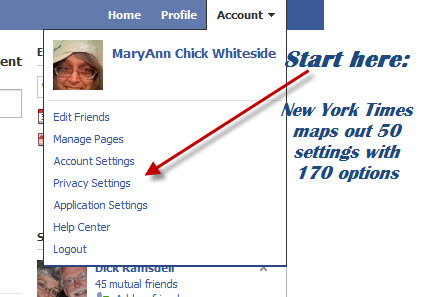
Setting privacy settings on Facebook requires many clicks

Find the complete graphic on
Wow. Send out a thank you to the New York Times which uncovered the privacy settings for Facebook: 50 settings with 170 options.
An article, The price of Facebook Privacy? Start clicking, and a graphic maps out what you can do with Facebook's general privacy settings, ads and application settings.
Plus the NYT shares information like the growth spurt of the Facebook privacy policy:
- 1,004 words in 2005; 5,830 words in 2010
- Longer then the United Staes Constitution without the amendments.
I tend to recommend Friends or Only Me settings for most people, cautioning that once you put something on the Internet consider that someone somewhere will know at some point in time.

May 12, 2010
When you hear 'journalist' what do you see? Database collects 75,000 images

Your age might be a predictor of the image that the word journalist pops up in your mind. But if you've got the time, the Image of the Journalist in Popular Culture database can show you about 75,000 different entries.

There are video, photos, and hundreds of articles that feature journalists in a variety of roles.
Perhaps one of my favorite parts is the Sob Sisters parts that shows the conflict of female journalists: "How to incorporate the masculine traits of journalism essential for success – being aggressive, self-reliant, curious, tough, ambitious, cynical, cocky, unsympathetic – while still being the woman society would like her to be – compassionate, caring, loving, maternal, sympathetic."
The opening essay highlights some of the conflicts, including:
"... does anyone really want to be Hildy Johnson chasing after one more story or Lois Lane crying her eyes out because the person she loves is out saving the world and doesn’t have time for domestic tranquility or Mary Richards, widowed and penniless, trying at the age of 60 to make one more comeback in television news, or Murphy Brown raising a child and battling breast cancer while still holding on to her number one position in TV news ..."
Here's what Joe Joe Saltzman, professor of journalism at the USC Annenberg School for Communication. says we'll find among the 75,000 entries on journalists, public relations practitioners and media in the Image of the Journalist in Popular Culture database:
- Television (27,000 items);
- Films (19,500 movies, movies made for TV and miniseries);
- Fiction (12,300 novels, 1,550 short stories, 500 plays and 200 poems);
- Radio (2,900 items);
- Cartoons, Comic Books & Comic ... See MoreStrips (5,900 items);
- Non-Fiction (Documentaries, News, Sports, 3,150 items);
- Humor (710 items);
- Commercials (350 items);
- Games (140 items);
- Music (Songs-Compositions, 95 items);
- Internet-Websites (90 items),
- Art (40 items).
- print journalists (from large urban newspapers to small country weeklies, including editors, reporters, photojournalists, correspondents, columnists, publishers, newsboys),
- broadcast journalists (from networks to local stations including reporters, anchors, correspondents, producers, writers, technical personnel, news directors, station owners, network executives and management),
- public relations practitioners (from press agents to publicists), and
- the news media (anonymous reporters who show up in countless films and television movies ranging from press conferences to packs of reporters shouting questions or chasing after the main character to individual reporters asking questions).
- If you want to see all the entries, don’t fill in any of the query categories and simply hit submit
- If you’re interested in a particular film or novel or any other popular culture title, fill in the TITLE query
- If you’re searching for a particular journalist (a columnist, a critic, an editor), a specific actor or a specific group (African-American or Female or Gay for example) simply fill out the COMMENTS query.
- If you’re only interested in movies or novels or poems or humor, simply click on the TYPE or types you are interested in and only those entries will show up.
- If you want to see if your favorite author is included, go to the AUTHOR column and type in LAST NAME followed by a comma, and then first name.
- If you’re interested in a specific country, type that country’s name in the REFERENCE query.
- Each column can be set up in ascending or descending order by simply clicking on it.
- If you want to read more about any individual title, click on the title itself.
- If you want to borrow some title from the IJPC Collection of more than 12,000 DVDs, then check the FORMAT column to see if it’s available.
Go. Enjoy.
May 11, 2010
Imagine if life were like Facebook

A group took those things we say and do on Facebook and turned them into a video. Go ahead, click Facebook In Real Life on Facebook or on the Crossroads web site You need a laugh today.
Next up: When Facebook is your life -- now, that's a real laugh.
By the way, Crossroads, which produce the video, says it is for those who have given up on church, but not God.
May 10, 2010
Unfinished business stays that way
I'm playing butterfly today. You know, those times when you flit from project to project, place to place, and unfortunately, blog post to blog post.
I'm picking up nuggets of thoughts from here and there. I start pulling it together and suddenly I see a brighter and sweeter flower. How can I resist? I just looked and I.see I once again have more draft posts then published posts :( for the year.
Maybe I should go work on those Facebook pages that are demanding attention.
Or maybe I'll go study that butterfly quilt once more and nap.
The nap is needed because either we need to sleeping pills for dogs or a way to train them to sleep from midnight to 8 a.m.
I'm picking up nuggets of thoughts from here and there. I start pulling it together and suddenly I see a brighter and sweeter flower. How can I resist? I just looked and I.see I once again have more draft posts then published posts :( for the year.
Maybe I should go work on those Facebook pages that are demanding attention.
Or maybe I'll go study that butterfly quilt once more and nap.
The nap is needed because either we need to sleeping pills for dogs or a way to train them to sleep from midnight to 8 a.m.
May 8, 2010
Share on Saturday: Why 4 easy steps ensure popularity on Facebook
I could have published this post early Thursday morning. Instead, I'm listening and waiting for this blog post to hit Facebook on Saturday.
That simple step might be key to spreading the word on Facebook. Think weekend, numbers and sex. Or post about Facebook.
Hat tip to the News Leadership Blog through the Knight Digital Media Center for its summary in 3 tips for getting your stories shared on Facebook
But head to Dan Zarrella's blog for a post on "Data shows on Facebook sex sells."
Learn why it pays to post on weekends if you're looking for something to spread. Here's a hint: How many employers now ban Facebook and other web sites?
Be stunned to learn that digits in headlines help in popularity.
Then find out why including Facebook, why or world make a post more likely to get shared on Facebook.
(By the way, these blog posts are now flowing onto my Facebook page. The page was created in 2007. I dusted it off as I ramp up to more Facebook work. It's much easier and safer to experiment with FBML and other things there instead of on the clients' site.
Some pages grow faster then others - Soyla's Mexican Cuisine is up to 60 fans/likers while the main Facebook page for Girl Scouts of Southeastern Michigan is around 1,800 fans/likers). Meanwhile, I'm working on revising the Facebook 101 classes - again! -- and adding a Facebook for Small Businesses 101 class. That's one setting where Dan's research will come in handy.)
That simple step might be key to spreading the word on Facebook. Think weekend, numbers and sex. Or post about Facebook.
Hat tip to the News Leadership Blog through the Knight Digital Media Center for its summary in 3 tips for getting your stories shared on Facebook
But head to Dan Zarrella's blog for a post on "Data shows on Facebook sex sells."
Learn why it pays to post on weekends if you're looking for something to spread. Here's a hint: How many employers now ban Facebook and other web sites?
Be stunned to learn that digits in headlines help in popularity.
Then find out why including Facebook, why or world make a post more likely to get shared on Facebook.
(By the way, these blog posts are now flowing onto my Facebook page. The page was created in 2007. I dusted it off as I ramp up to more Facebook work. It's much easier and safer to experiment with FBML and other things there instead of on the clients' site.
Some pages grow faster then others - Soyla's Mexican Cuisine is up to 60 fans/likers while the main Facebook page for Girl Scouts of Southeastern Michigan is around 1,800 fans/likers). Meanwhile, I'm working on revising the Facebook 101 classes - again! -- and adding a Facebook for Small Businesses 101 class. That's one setting where Dan's research will come in handy.)
May 6, 2010
Simple explanation very inviting

I grabbed a snapshot because sometimes a picture is worth a thousand words.
Note: If you want to know about the service and its preview head over to LouisGray.com for Regator Revamp Adds Blog Tremds. Monitoring, More.
April 30, 2010
Seriously, you thought you could hide forever

Perhaps it comes from growing up in a community where many eyes watched and reported the moves of members. Or maybe I learned that private actions are limited while digging through reports, listening to speeches and asking questions to create articles for newspapers, the web and books.
Or maybe I've lived through enough private networks becoming public, seen enough innovations wipe out previous practices and endured company ownership changes that render lifetime guarantees useless.
Teach privacy impossible
So Facebook wants to take over the world.So Facebook will learn more about me if I share my likes within and off site. We already knew our reputations are dead.
Rather then worrying about teaching people how to keep their behaviors, thoughts and actions quiet why don't we teach them the basic truth that if you share it online someone will find it. Yesterday it was Google. Today it is Facebook. Let's see who is next.
That's a long way of saying I don't see why someone would be gleeful that they've managed to fool Facebook by listing concepts and values as interests and activities, a move that ensures useful ads are not served. I don't get playing hide and seek on Facebook.
One last time
I actually like those programs that tell me who I'm following across social networks, that serve up suggestions of what or who I might like.

Says O'Brien in Sorry, Google, but Facebook is the Web's most important company now:
"The problem with the social Web until now is that each time you joined a new site, you had to create a new identity and refind your friends and drag them along with you. That's a pain, and each time you really had to think about how much time you wanted to invest. You had to build dozens of social networks, try to manage them and remember to check them."
But the changes mean, O'Brien explained, that "now, your Facebook network will just travel with you seamlessly across the Web ... This will make social networking far simpler and more effective for the vast majority of users."
It does means Facebook has a ton of information about me. I'm OK with that. So does my credit card company, Comcast and a ton of others. Unfortunately, a Freedom of Information Act request won't let me know what all they know.
Just go, will you?
I'm OK with Tyler Romeo "not to be a copycat or anything but I'm leaving Facebook." He's going to leave a lot of things through the years.
Nothing in the conversation that followed when Louis Gray shared it on Google Buzz persuaded me to follow Romeo's example.
I still believe don't say it or do it if you don't want to see it on the front page of your "local newspaper." It's just that these days my "local newspaper" has morphed into a global online network.
April 29, 2010
More citizen journalist initiatives starting at Michigan newspapers

Looks like Michigan's Oakland Press will get help in expanding its citizen journalism pool.
Plus more Michigan communities will start relying on neighbors to help cover the news.
The Journal Register, which owns the Oakland Press, Macomb Daily, Royal Oak Daily Tribune, Morning Sun in Mt. Pleasant in Michigan and 13 other daily newspapers in Connecticut, New Jersey, New York, Ohio and Pennsylvania, partnered with SeeClickFix
A shared item on Facebook let me to this article in the Dearborn Press and Guide:
Newspaper group starts citizen journalist initiative.
"The partnership provides SeeClickFix portal pages on JRC Web sites that will allow users to observe, report and follow issues in their communities. Web site users will be able to create watch areas and track items ranging from poor road conditions to blighted buildings."
Think of it as a community neighborhood watch group for news.
The Oakland Press launched a citizen journalism academy in late 2008, even gained circulation when other Michigan newspapers cut back. But the move brought plenty of attention to the Oakland Press.
The company believes this partnership will benefit the communities by:
- Encouraging the audience to use the SeeClickFix platform to alert fellow residents of impact issues.
- Empowering residents to work with the company’s journalists to address community needs.
- Highlighting those who participate and make a difference through news reports.
How's that for a press release reprinted in a newspaper as if it were a story.
The press release at the company site says:

The company expects to expand its network to its other properties, including the other weekly newspapers in Michigan. Those include the Advisor and Source in Shelby Township, Voice Newspapers, Southgate News-Herald, Heritage Newspapers and Morning Star Network, according to the company website.
Meanwhile, the Rapidian on the west side of Michigan is going strong.
Create or die
We are also about a month away from a Journalism That Matters unconference in Detroit.

The idea behind the event is "How can we reshape journalism so that it engages and serves all people & communities?"
A Facebook announcement said:
"A focused, three-day gathering of results-driven journalists, entrepreneurs, programmers, technologists, bloggers, videographers, funders, venture capitalists, artists and educators to discover, assess, shape and create new enterprises and new approaches to participatory media and civic journalism. We'll meeting in St. Andrew's Hall, a National Register-listed former church, with
state-of-the-art TV production facilities next door, and dormitory suite or hotel accommodations.
Learn about Detroit's changing economy as a metaphor for the journalism change and opportunity. Arrive Thurs., June 3, at mid-day, begin with an afternoon orientation, buffet dinner and evening program. Share/work Friday and Saturday using circle-round and break-out 'unconference' collaboration; wrap up and commit to next steps on Sunday morning."
Some expectations:
- New and unexpected cross-sector collaborations
- Broadening a community of practice among people who care about journalism innovation
- Nurture and develop journalism entrepreneurship especially for underserved communities and people of color
- Learn from stories of successful projects
- Discover and engage financial/funding sources to seed new projects
Developing the program has started, but much of it depends on who shows up.
I'm registered to go, expecting to work behind the scenes capturing and then sharing some of what is discovered at the event. A few obstacles for me to overcome, but I think some exciting conversations will happen.
April 28, 2010
You can play hide and seek on Facebook
A recent rash of invites to see who has visited my Facebook profile and now a post on how to "stay invisible on Facebook" leaves me confused.
Personally, I want people to visit my profile. I want them to see what I said and I want to read what they write, share, or comment about. I'd love to know how many people just drift by my wall without leaving a shadow.
I never quite got why creating a collage of mug shots of visitors was an application that appealed to so many of my Facebook friends.
Robb Montgomery calls it staying invisible on Facebook.
He sees it as desirable as his lack of traditional interests listed in his profile ensures he keeps his data. After all, how many advertisers are seeking those intersted in "Truth, Grace, Redemption ...."
It means none of the Facebook ads are likely to garner a click from him.
Personally, I'll share some interests and even look at some ads as a way to ensure Facebook stays in business.
I once only shopped at businesses who advertised with my employer. I only used coupons delivered through my employer. It was one small step to assure advertisers that their ads and coupons worked.
I don't want to - and won't - pay a fee to Facebook.
Robb says:
Personally, I want people to visit my profile. I want them to see what I said and I want to read what they write, share, or comment about. I'd love to know how many people just drift by my wall without leaving a shadow.
I never quite got why creating a collage of mug shots of visitors was an application that appealed to so many of my Facebook friends.
Robb Montgomery calls it staying invisible on Facebook.
He sees it as desirable as his lack of traditional interests listed in his profile ensures he keeps his data. After all, how many advertisers are seeking those intersted in "Truth, Grace, Redemption ...."
It means none of the Facebook ads are likely to garner a click from him.
Personally, I'll share some interests and even look at some ads as a way to ensure Facebook stays in business.
I once only shopped at businesses who advertised with my employer. I only used coupons delivered through my employer. It was one small step to assure advertisers that their ads and coupons worked.
I don't want to - and won't - pay a fee to Facebook.
Robb says:
"The choice to have your data sold and traded by people who are not paying you for it is up to you. If you want to lower your Facebook “book value” - your advertising revenue profile - then simply take a look at your profile details from a marketer’s viewpoint and remove specific types of information that identify your branding preferences."I practice good privacy efforts. It's OK for a business to make money from me. They always have.
April 27, 2010
Moving on: Cleveland.com exec moving (to) Sideways

Advance
Internet
Eliza Wing, president and CEO of Cleveland.com, is the new president and COO of Sideways, a software company based in Cleveland that wants to convert books into multimedia experiences to take advantage of the iPad and other mobile devices.
New look at books
Launch of Sideways, founded by the founder of books.com, is 27 days away, according to a company web site. Wing gave cleveland.com more details, saying the new company would formally launch at the BookExpo America conference in New York City on May 25.
It must be hard for Wing to leave Cleveland.com, a site that she helped form after moving from The Cleveland Plain Dealer's editorial department. She was named editor-in-chief for Plain Dealer New Media in 1996 to work on the development of a news and information site for Cleveland and named president and CEO in 1997.

Sweet reunion
But, in some ways, it must be a comfortable move. Wing was editorial director for book.com, the first Internet book store, from June 1995 until February 1996.
No successor was named, according to a cleveland.com article where she also said:
"I think cleveland.com is at a place in its history when its ready to take the next step and I'm excited for the company. We're exceeding our revenue goals and our audience is continuing to grow. There's just so much more to do. That was part of what made the decision so hard."
In the past
Wing worked at Rolling Stone and New York Woman before following her then-husband to Cleveland for his new job at the Rock and Roll Hall of Fame. That's when the mother of two started in the editorial department of the Ohio newspaper. That soon led to what became cleveland.com, the online affliate of the Plain Dealer.
Learn more about Eliza Wing, including the first time she lived in Ohio, how she started in the news business, and the fine art of "juggling the workplace as a hockey mom" in a 2005 profile on Clevelandwomen.com.
Online and active
We've met through the years at Newhouse events, new media conventions and, of course, online. She tweets. has a Google profile and she blogs (just not lately.) She graduated from the University of Michigan, but let's not hold that against her.
April 26, 2010
Regret the error, not repeat the error

Poor Matt Millen. He can't win.
Rob Otto over on mlive.com ensures that Millen's mistake - a comment about who likes fried bologna sandwiches - isn't limited to ESPN watchers. He found a YouTube video with a label that deserves another round of apologies. He shares it in a Ottoman Empire post under the headline "Matt Millen discovers whole new way to embarrass himself at the NFL draft."
Otto should share the embarrassment with his choice of videos.
One of my first bosses at The Flint Journal pounded into me the importance of not repeating an error when publishing a correction. He's also the one who shared the web address with me, knowing I'd smile and start thinking about blue skies and perfection.
April 22, 2010
Like: Facebook’s ambition to sweep the web

Although this week's announcement focuses on companies like Pandora getting the shared like button, I think the move will increase the need for the smaller businesses and organizations making sure they are a part of the Facebook network.
Creating a page/mini-site within Facebook will be the easiest way. Still, for many organizations even this will be a challenge as the requirements for Facebook success goes beyond words and visuals. Regular updates and frequent interactions are keys to success.
A Facebook site is not something to just hand off to a third-party for design and implementation. It takes integration within the organization. It means making interaction part of the company's daily infrastructure. It means making openess more then "my door is always open" from the top executives.
Lots of talk on the web, but technical evangelist Robert Scoble pulls together a good summary of the news, what it means, links, and video in a s post on Facebook’s ambition. The man who Facebook dropped for 24 hours once explores the scariness of the new effort and shares a conversation with Facebook founder Mark Zuckerberg:
Scoble suggests that the Facebook moves completed "a major piece of commerce infrastructure that would affect our lives for decades" and compared it to the completion of the railroad tracks across the United States.
"Today I told Zuckerberg that he now has the modern-day railroad in his grasp and challenged him to both win our trust and not abuse the major power he’s going to aggregate."
"It opened the west. Made new careers possible. Let fresh food from California get to Chicago before it spoiled and all that. But it created an organization that had a LOT of power that wasn’t always used well."It's up to businesses, organizations and people, whether they are friends, members, fans or likers, to become the check on Facebook. You won't get that by staying away or by jumping in only to answer random quizzes and play games.
Updated April 26, 2010 to fix typo in Scoble quote so that it now reads new careers, not few careers.
Right word won't roll off tongue or keyboard for non-conformists, new products

What do you call a product that will bring together diverse information and publish it many forms?
How much baggage does a new word carry when it is created from old words?
If you were fast, you read that I called Dan Paecho an ex-journalist in a post on his newest venture of presenting the news, a venture called FeedBrewer.
I called him that based on a conversation months ago when I was struggling with how many months out of the newsroom makes you an ex-journalist. The conversation was prompted partially by Wired Journalists decision to limit its network to only journalists.
Over on Twitter, we "discussed" how seeing the ex-journalist in the headline got Dan to "realize I'm not ready to ditch the "journo" description" even though he had for a short time at least.
Indeed, his Twitter bio once again just says journalist, with no sign of the former journalist label that was there. So I changed the headline to read journalist before Dan said that was unnecessary.
Dan says:
"Ex just sounds so final. I prefer "former" (although I since removed that too). I'm all mixed up."
Perhaps "journovator?"
Indeed, Dan is mixed up, mixed up in trying to innovate within a traditional field. He's not alone - check out a Twitter list he maintains and you'll see the names of people who have spent time in and out of newsrooms experimenting with different ways to find the news, define the news and present the news.
I can't tell you when a person needs to give up the journalist title.
And no one could call Dan a traditional journalist. His new venture, FeedsBrewer, will take him further out of the newsroom. Says Dan:
"We need a new term for people who help journalism happen all around them, vs. the traditional definition (only doing it yourself)."journo" description. Perhaps "journovator?""
Although there are people with interests in journalism and innovations, I'm not ready to bless journovator. Can you say it with a straight face?
Dan's Tweeted reply was:
"I dunno, I think "journovator" sounds like it was made for t-shirts -- which is the litmus test for good names."
I think there are terms for people who help journalism happen - publishers, editors, advertisers, news sources, etc. None of those fit what Dan or his journovators are doing. But I don't have a better idea.
Brewing information
I also don't have a better name for his new venture even after talking about it on Twitter. I started with:
"What we should talk about is @feedbrewer The name generates an image of cooking up RSS feeds"
The Feedbrewer logo (which I've mangled above with words) should inspire thoughts of brewing coffee. Twitter talk also suggested comparing the venture to the act of brewing beer or coffee.
From Dan comes this:
"Think brew as in beer or coffee, not witches' brew. Who knows, perhaps we will make homebrew for a launch party :-)"I'm sure they've done research and Dan says:
"Personally, I think FeedBrewer rocks as a name. It brews feeds into delicious eye candy. One day, maybe beverages, too."But when I hear FeedBrewer, I think of RSS feeds pulled into one device for reading. Or perhaps I'm thinking of Feedburner.
I understand I'm in the minority just by knowing of RSS feeds and Feedburner. I know no one put me in charge of language today. But this language thing boggles my mind.
Perhaps InfoStew better reflects this new product, new venture. I can serve stew with its mixture of vegetables and meat in a bowl, over rice, or a mound of potatoes. The product delivers information in a write once, read many ways and places. (Wasnt't write once, read multiple places the dream of the website language html?)
Guess I need to wait for the product to understand what is being said on Feedbrewer's web site and Facebook page.
Crusading for print?
Or perhaps I'm just ornery right now. Another cross platform conversation - started on Twitter, moved onto Facebook, then switched to email - on my crusade for print journalism - ended with an equal amount of frustration.
I never thought of myself as crusading for print, more for journalism, more for the sharing of information in interesting ways, or the telling of stories in multiple mediums.
Look at my past. Even while working for a newspaper company, I pushed for delivering news and information via phone, fax and online. My non-work time went to creating a community computer network that remains alive (barely) 16 years later, to putting Girl Scout information on an email list, on gopher and then the newly World Wide Web.
Crusading for a title
Look at my now. I'm pulling and pushing for information on Facebook, on Twitter, on FriendFeed for Girl Scouts, small businesses, and class reunions.
My eyes now light up as I talk about social gaming and figuring out the puzzles presented by FarmVille for those who call me guru, boss and expert.
I get excited (still) about new product launches, ideas for ensuring a community's stories are shared, and the restructuring of organizations that didn't realize soon enough that most women work now, often for businesses that release work schedules on Friday for the next week.
Now, if only I could find the right word to describe who I am. Retiree ain't cutting it with me.
April 21, 2010
Let's start over, please

Funny. I just wrote peaking through the crowd when I meant clouds. Or did my fingers know what my brain sometimes forgets.
The first status, posted on Facebok on April 13, 4:30 p.m. said:
Days like today help me understand how stereotypes begin. I don't like that. But I'm not real happy with many males today either!Go ahead. Imagine the type of behavior that would encourage me to understand why males gain a reputation for being uncommunicative, or bossy or easily amused by unfunny experiences. Or how many times they speak in sports language, expecting the non-athletic to understand the secret language created on courts, courses and fields. I can probably top what you thought with what took place.
Still, that's not the thinking I want to encourage or the people I want to hang with so I decided to change the only thing that I can: My attitude. That led to this Facebook status at 5:44 p.m.:
OK. Let's start over. Good morning world.Who said my day had to start in the a.m. or when sun popped up.
The status prompted responses such as:
"Good morning. have you had your V-8 yet? A good way to start your morning.and, despite what I just said, my favorite one of all:
Hey, sunshine. Good day to you!"
"OK, so like in golf. We should get, say, 6 mulligans a year."I can get by with do-overs a year. Can you?
Subscribe to:
Posts (Atom)

 Posts
Posts


